
Part of the ‘Not Quite What You Meant’ series
By: Ezra Nadav
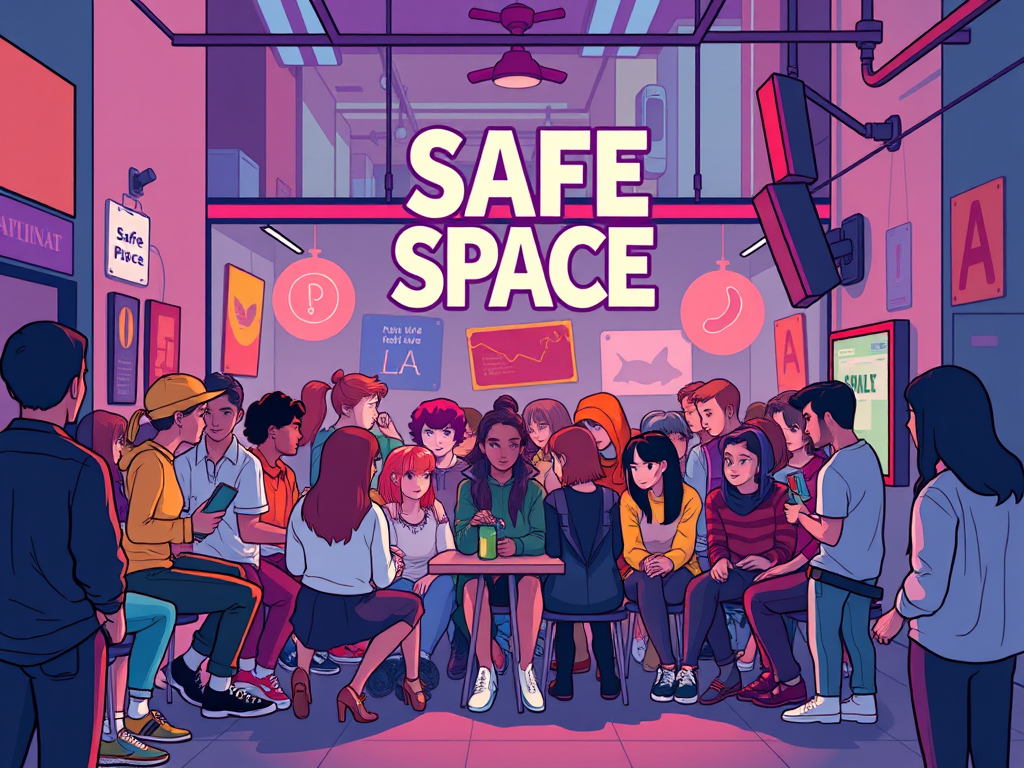
“This is a safe space.”
It’s a phrase that now comes standard with everything from workplace trainings to university classrooms and community groups. A warm-sounding promise. A shield against judgment. A balm for anxiety.
But more and more, I find myself asking: safe for whom?
Because when we peel back the label, “safe” doesn’t always mean what we think it does. Sometimes, it means comfortable, and comfort doesn’t always equal inclusion. In fact, comfort can be the very thing that keeps marginalised voices on mute, ensures dominant norms stay unchallenged, and stifles the kind of tension that real growth demands.
So perhaps the better question is not, “Is this a safe space?” but “Is this a courageous one?”
The Origins and Intent of Safe Spaces
The original purpose of “safe spaces” was both radical and restorative. Emerging out of feminist and LGBTQ+ activism in the 1970s and 80s, these spaces were not about sheltering people from opposing ideas; they were about creating sanctuaries where trauma, identity, and difference could be named and validated without fear of retribution or violence (Fox, 2007; Holley & Steiner, 2005).
For many, particularly those carrying the scars of marginalisation, these environments were not only healing but necessary. They were safe not because they were easy, but because they provided affirmation, solidarity, and the conditions for honest self-expression.
The Shift: From Safety to Comfort
Over time, however, the term “safe” has been adopted more broadly, and sometimes co-opted, in ways that dilute its meaning. In some contemporary settings, “safe space” has come to signify emotional ease and the avoidance of discomfort. This shift has often been driven by those with social, institutional, or identity-based privilege.
According to Arao and Clemens (2013), this overreliance on emotional comfort as a metric for safety can backfire. It often centres the feelings of dominant group members and sidelines hard conversations about power, oppression, and justice. What is experienced as “unsafe” by some may simply be the discomfort of being challenged.
When the goal becomes avoiding hurt feelings rather than reckoning with harm, the result is often a form of silence, one that protects fragility rather than fosters inclusion (DiAngelo, 2018).
Recent research has echoed these concerns. Jordan Peters (2022) notes that the rise of comfort-oriented discourse can inadvertently reinforce echo chambers, where critical dissent is seen as threat rather than engagement. Similarly, Putnam and Campbell (2020) explore how social trust and cohesion are actually strengthened through exposure to diverse viewpoints and values, not diminished by them.
Introducing Courageous Spaces
Recognising this challenge, educators and diversity practitioners have offered an alternative: courageous spaces. First coined in contrast to safe space narratives, this term emphasises the need for intentional environments that support open dialogue, vulnerability, and growth.
Courageous spaces, as outlined by Singh, Meng, and Hansen (2013), do not discard safety altogether. Rather, they redefine it: safety is found not in avoiding conflict but in establishing shared commitments to respect, accountability, and curiosity.
In a courageous space, discomfort is expected, even welcomed, as a necessary part of learning and unlearning. As psychologist Brené Brown (2012) puts it, “You can choose courage or you can choose comfort. You cannot have both.”
Newer scholarship by Levinson and Tang (2021) supports this approach, advocating for discomfort as a pedagogical tool, especially in equity-focused education. Their findings show that when participants are scaffolded through challenging dialogue with structured reflection, long-term empathy and perspective-taking improve dramatically.
The Paradox of Safety
Here lies the paradox: one person’s sense of safety may come at the cost of another’s dignity. For some, “safety” means not being forced to confront uncomfortable truths. For others, safety is only possible when those truths are named.
Social psychologist Claude Steele (2010) highlights how stereotype threat and identity threat can shape how safe a space feels to marginalised individuals. What may feel like a neutral or “comfortable” space for one group may feel loaded with microaggressions, exclusion, or tacit hostility for another.
This tension reveals a critical truth: safety cannot be assumed. It must be co-created, negotiated, and understood through the lens of power.
So What Do We Actually Need?
We need to move beyond binaries of safe vs. unsafe and ask: What are we protecting? Whose comfort are we preserving? And at what cost?
Creating truly inclusive environments means making room for discomfort, not for its own sake, but because growth, change, and justice live there. It means establishing the ground rules and relational agreements that allow people to take risks, speak truth, and stay at the table.
This includes:
- Norms that value curiosity over certainty
- Agreements around calling in rather than calling out
- A shared understanding that harm and discomfort are not the same thing
- Willingness to engage in repair and learning when mistakes happen
These are the building blocks of spaces that are both psychologically safe and intellectually courageous (Edmondson, 1999).
Conclusion
“This is a safe space.”
Maybe it’s time we get more specific. Do we mean that people won’t be harmed? That they won’t be challenged? That everyone will feel good all the time?
Or do we mean that in this space, we agree to stay present when things get tough? That we commit to growth over comfort? That we centre dignity and accountability, not ease?
In other words: This is a courageous space.
Shalom Aleichem
References
Arao, B., & Clemens, K. (2013). From Safe Spaces to Brave Spaces. The Art of Effective Facilitation. Stylus Publishing.
Brown, B. (2012). Daring Greatly: How the Courage to Be Vulnerable Transforms the Way We Live, Love, Parent, and Lead. Penguin.
DiAngelo, R. (2018). White Fragility: Why It’s So Hard for White People to Talk About Racism. Beacon Press.
Edmondson, A. (1999). Psychological Safety and Learning Behavior in Work Teams. Administrative Science Quarterly, 44(2), 350-383.
Fox, C. (2007). The Trouble with “Safe Spaces.” The Review of Education, Pedagogy, and Cultural Studies, 29(3), 257-282.
Holley, L. C., & Steiner, S. (2005). Safe Space: Student Perspectives on Classroom Environment. Journal of Social Work Education, 41(1), 49-64.
Levinson, M., & Tang, A. (2021). Uncomfortable Conversations: The Pedagogy of Discomfort in Practice. Harvard Educational Review, 91(1), 85-108.
Peters, J. (2022). Comfort Culture and the Crisis of Dialogue. Journal of Critical Social Psychology, 4(2), 113-128.
Putnam, R. D., & Campbell, D. E. (2020). The Upswing: How America Came Together a Century Ago and How We Can Do It Again. Simon & Schuster.
Singh, A. A., Meng, S., & Hansen, A. W. (2013). “It’s Already Hard Enough Being a Student”: Developing Culturally Inclusive Brave Spaces. The Journal of LGBT Issues in Counseling, 7(4), 353-365.
Steele, C. (2010). Whistling Vivaldi: How Stereotypes Affect Us and What We Can Do. W. W. Norton & Company.
 On Second Thought
Leave a comment