
Genesis as the Story of Every Human Life: Part 4
A part of the ‘On Second Thought‘ series
By: Ezra Nadav
Previously in the Series:
In Part 1: Conception and Innocence, we explored the beginning of life, both in the world and in ourselves. Eden is a place of trust, safety, and unearned goodness. But it is also a place we cannot stay. The gift of innocence is precious, but not permanent.
In Part 2: Knowledge and Estrangement, we stepped into the complexity that follows awakening. Shame, freedom, envy, and consequence enter the story. We are no longer protected by simplicity. We become moral beings, capable of both destruction and repentance.
In Part 3: Covenant and Identity, we followed Abraham, Isaac, and Jacob as they each began to form lives marked by calling and conflict. Identity was not given to them in full; it was forged through dislocation, silence, struggle, and blessing. Covenant does not bypass uncertainty, it transforms it.
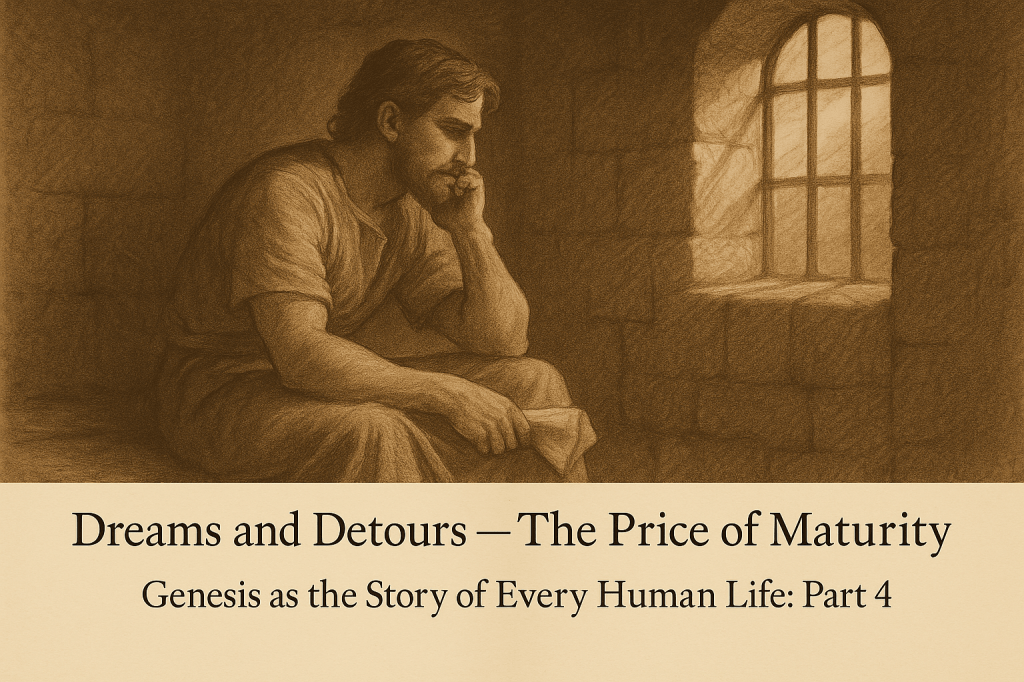
Now, in Part 4, we meet a dreamer. And a prison cell.
Dreams and Detours — The Price of Maturity
Joseph is the first character in Genesis whose life reads almost like a novel. We meet him as a boy with grand dreams and see him grow into a man of integrity, resilience, and wisdom. But his journey is anything but linear.
He is favoured, then betrayed. Gifted, then discarded. Elevated, then forgotten. Dreaming of greatness, he finds himself in a pit.
At first glance, Joseph seems like the golden child, beloved, talented, protected.
But beneath the surface, his story is one of deep internal transformation. He begins as someone who sees the world through promise and privilege. He ends as someone who understands pain, providence, and the power of forgiveness.
What connects those two selves is not success. It’s delay.
It is the detour that shapes him.
When the Dream Doesn’t Come True (Yet)
Joseph’s story mirrors the season of life when we first try to make something of ourselves, and discover the world is far more unpredictable than we hoped.
He is sold by his brothers, falsely accused, and imprisoned. His gifts are real, but unrewarded. His kindness is returned with forgetfulness.
He waits.
Two years.
Then more.
There is no voice from Heaven. No burning bush. No angel at the door. Just silence.
Unlike his ancestors, Joseph receives no direct communication from G-d. He must interpret, both dreams and delays. He must find meaning not through miracles, but through patience.
This is the terrain of spiritual adulthood, where we are asked to trust not because we feel something, but because we remember something. Where faith matures from fire to ember, and hope becomes a quiet discipline.
Power and Restraint
Perhaps the clearest sign of Joseph’s growth is what he does with power.
As a teenager, he uses truth to elevate himself. Later, as Pharaoh’s second-in-command, he uses it to preserve life. He chooses mercy over vengeance. He feeds the ones who abandoned him.
That moment when Joseph reveals himself to his brothers is one of the most moving in all of Genesis:
“I am Joseph. Is my father still alive?” (Genesis 45:3)
They are speechless. He could have made them suffer. Instead, he embraces them.
He reframes the harm, not to excuse it, but to show that his story, like theirs, has been folded into something larger.
“You intended to harm me, but G-d intended it for good, to accomplish what is now being done, the saving of many lives.” (Genesis 50:20)
This is not naïveté. It is not erasure. It is the hard-won wisdom that comes only from walking through the valley and coming out whole.
The Work of Maturity
Maturity isn’t measured by what we achieve. It is revealed in how we respond when things do not go as planned. In how we carry disappointment without bitterness. In how we serve quietly, when no one sees. In how we hold power without needing to prove anything.
Joseph models a kind of adulthood that feels deeply relevant:
• A life lived without direct divine intervention,
• A story shaped by both injustice and insight,
• A heart that forgives without forgetting.
He becomes someone trustworthy not because he was protected, but because he was tested. And still, he does not claim to understand everything. He names G-d’s hand in his story, but only at the end. Only once he sees the larger arc.
Until then, he waits.
He works.
He listens.
The Detour is the Road
There is no triumphant march from dream to destiny. There is descent. Delay. Sorrow. And, eventually, clarity.
The detour is not a mistake. It is the terrain on which we become the kind of person who can hold the dream with integrity.
Joseph teaches us that leadership without wisdom is dangerous, and wisdom without humility is empty.
And so, like him, we wait. We serve. We forgive. We begin again.
The dream is not abandoned. It is transfigured, from ambition into calling, from ego into service, from self into legacy.
Coming Next:
In Part 5: Blessing and Legacy, the story slows to a whisper. Jacob, now old, gathers his sons. Joseph reflects on what has been.
This is the stage of reckoning and release, where we no longer ask how high we’ve climbed, but how deeply we’ve loved, and what we’ve made possible for those who will come after us.
Shalom Aleichem
Acknowledgment & Further Reading
This reflection draws on the Book of Genesis and its interpretive legacy within Jewish and Christian traditions. While the words and interpretations are my own, I am indebted to the centuries of commentary, midrash, and modern scholarship that continue to illuminate these ancient texts.
In particular, the themes explored in Part 4, of spiritual formation through delay, the silence of G-d, and the transformation of power through forgiveness, echo ideas found in the works of:
- Rabbi Jonathan Sacks zt”l, particularly his Covenant & Conversation series
- Walter Brueggemann, especially Genesis: Interpretation: A Bible Commentary for Teaching and Preaching
- Avivah Gottlieb Zornberg, whose literary and psychoanalytic readings of Genesis offer a rich lens on Joseph’s inner life
- Michael Fishbane, Biblical Interpretation in Ancient Israel
- Thomas Mann, Joseph and His Brothers (for a literary reimagining)
The narrative of Joseph, like all sacred text, continues to speak in new ways. My hope is simply to listen well and reflect honestly.
 On Second Thought
Leave a comment