
Genesis as the Story of Every Human Life: Part 6, the Final Installment
A part of the ‘On Second Thought‘ series
By: Ezra Nadav
Previously in the Series:
In Part 1: Conception and Innocence, we stood in the Garden, in that wordless, early knowing of goodness and belonging. Life began not with striving, but with being. We remembered what it means to be held before we could speak, to be called good before we could earn it.
In Part 2: Knowledge and Estrangement, the world cracked open. Self-awareness brought shame, fear, and exile. We began to see the cost of freedom, the burden of knowledge, and the ache of moral responsibility. Innocence faded, and with it came both loss and agency.
In Part 3: Covenant and Identity, we entered the long road of becoming. Like Abraham, Isaac, and Jacob, we forged meaning through questions, through failures, through faith that didn’t always feel like certainty. Covenant was not a contract but a relationship, dynamic, tense, and transformative.
In Part 4: Dreams and Detours, we followed Joseph through betrayal, injustice, and hiddenness. It wasn’t the dream that made him wise, but the waiting. His greatness came not from vision, but from how he bore the slow work of becoming. He grew into someone who could forgive.
In Part 5: Blessing and Legacy, the arc bent toward conclusion. Jacob, nearing death, blessed each of his sons, not with flattery, but with truth. Joseph offered his brothers peace. And we were reminded that legacy isn’t control, it’s release. It’s the gift of perspective and grace handed down.
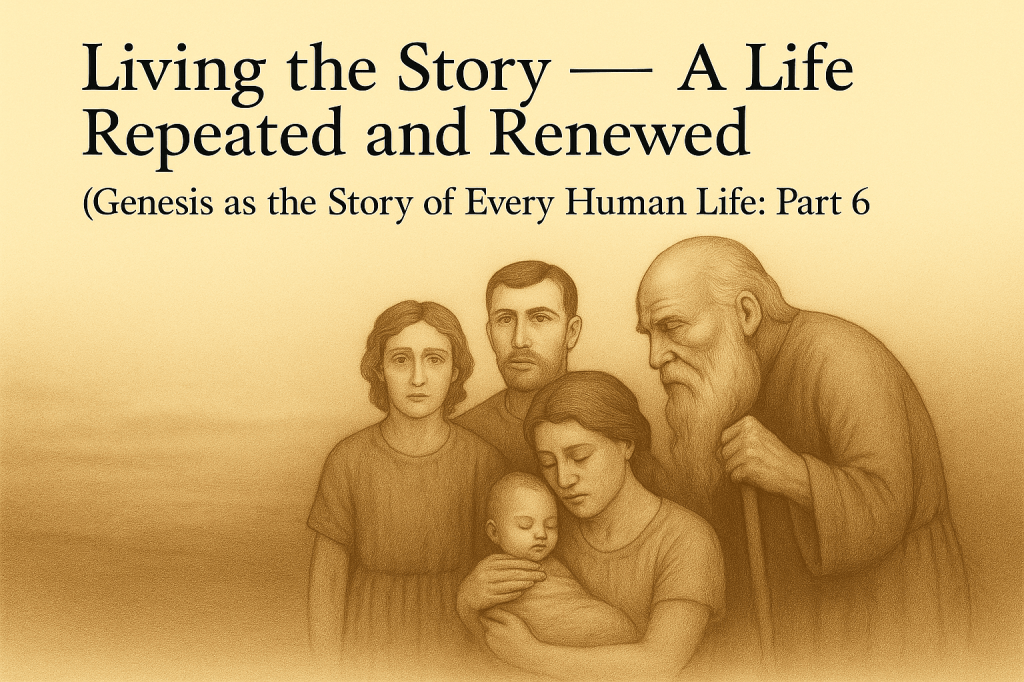
Now, in Part 6, the final instalment, we ask what this story has planted in us, and how it might be lived forward.
Living the Story: A Life Repeated and Renewed
Genesis ends quietly. There are no final miracles. No parting seas. No grand resolutions.
Joseph dies. The family remains in Egypt. The promise is not yet fulfilled.
And still, the story is complete, because it has done its work.
We may expect sacred texts to close with clarity. Genesis doesn’t. It closes with continuity.
It knows something modern culture forgets:
That life is not a ladder but a circle.
That endings are beginnings.
That we are never simply done, only paused. Planted. Preparing to rise again in a new form.
This Is Not the End, Only a Threshold
Genesis gives us a map. But it does not flatten our lives into a single journey from A to B.
Instead, it shows us that we live through these stages, Innocence, Estrangement, Identity, Detour, Legacy, not once, but over and over.
You will pass through them in your childhood.
Again in adolescence.
In the middle years. In grief. In recovery. In love. In leadership. In loss.
Some days will feel like Eden, others like exile.
Some years will feel like Egypt, beautiful, painful, fruitful, and temporary all at once.
This is not failure.
This is how wisdom forms.
The Sacred Spiral
We often imagine spiritual growth as linear, always forward, always upward.
But the sacred pattern is more like a spiral. You return to places you’ve been before, but not as the same person.
You may feel like you’ve regressed, but you haven’t.
You’re revisiting the old landscape with new eyes.
You’re bringing more honesty, more compassion, more clarity than you had the first time.
Genesis gives us permission to live this way, as pilgrims, not conquerors.
As people who circle the mountain again and again, each time higher and deeper at once.
How Do We Carry the Story Now?
You carry Genesis when you remember that you were good before you were useful.
You carry it when you say no to shame, even if you still feel it.
You carry it when you wrestle honestly, when you don’t fake certainty or skip the hard questions.
You carry it when you choose mercy instead of revenge, and when you bless people who may never thank you for it.
You carry it when you let go of needing the story to end neatly, and live inside the ambiguity with grace.
You carry it when you let your detours change you, rather than embitter you.
You carry it when you walk into something new, knowing that G-d walks with you, even if silently.
What Genesis Teaches Us About G-d
And perhaps most powerfully, Genesis teaches us something subtle about G-d.
That the Divine is not found only in intervention, but in accompaniment.
G-d is not always loud. Not always immediate. Not always obvious.
But G-d is present.
In the call to Abram.
In the wrestling of Jacob.
In the tears of Joseph.
In the silence between dreams.
Genesis does not resolve the problem of suffering.
But it reframes it.
Not as punishment, but as passage.
Not as absence, but as mystery.
Not as an exception, but as a core part of what it means to be human and sacred all at once.
Begin Again — But Differently
So now, you begin again.
Not from the beginning, but from here.
You are not who you were.
You are not Eden, but you remember it.
You are not Jacob, but you know what it means to wrestle.
You are not Joseph, but you know the ache of being misunderstood. and the miracle of finding peace anyway.
The story lives in you now.
You are not just a reader.
You are a bearer of this ancient rhythm.
And like the scrolls themselves, passed hand to hand for generations, you are now part of the telling.
Final Benediction:
May you walk with courage through your detours.
May you bless others without waiting to be repaid.
May you wrestle with integrity, love with boldness, and rest in the knowing that you are part of something ancient, unfinished, and deeply good.
And when your time comes to speak a blessing, may it be rooted in truth, softened by mercy, and generous enough to outlive you.
Shalom Aleichem
 On Second Thought
Leave a comment