
Even The Onion Wouldn’t Dare
Part of the ‘Not Quite What You Meant’ series
By: Ezra Nadav
There are moments in history so jarringly surreal, so wholly unmoored from moral consistency, that even the most cynical satirists would hesitate to write them. They’d scrap the sketch for being too far-fetched. Too offensive. Too on-the-nose. But reality, it seems, doesn’t share that restraint.
You stare at a headline like this and instinctively wait for the punchline, but there isn’t one. No parody, no wink, no distancing irony. Just a bleak, steady drumbeat of absurdity dressed in the language of moral high ground. It’s not the rise of satire; it’s the collapse of sincerity.
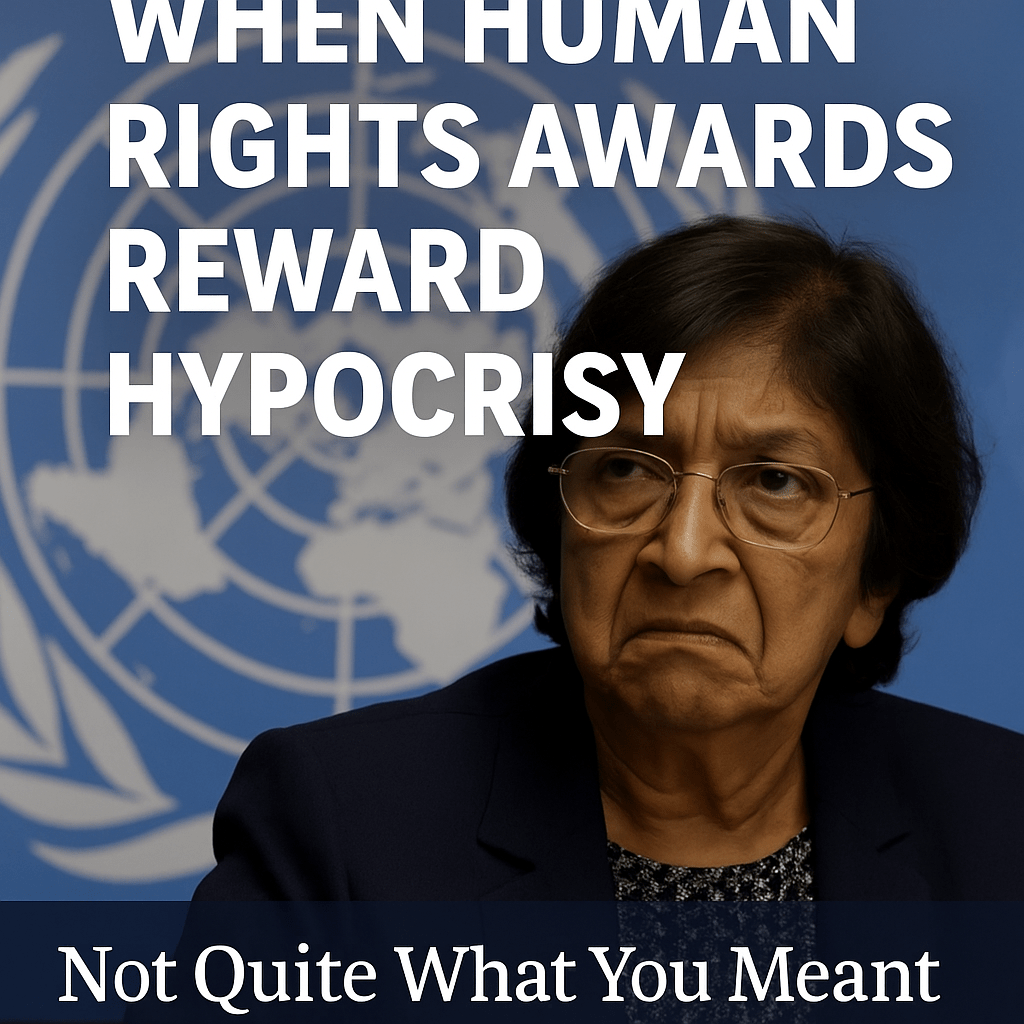
The 2025 Sydney Peace Prize has been awarded to Navi Pillay, former UN High Commissioner for Human Rights and a figure who has spent much of her public career levelling unrelenting, often unbalanced criticism at Israel. Under her leadership, bodies meant to uphold universal human rights became platforms where Israel was singled out with a frequency and ferocity that defied both proportion and precedent.
Now, she’s being celebrated for “a lifetime of advocating for accountability and responsibility in the face of crimes against humanity.” It’s a statement so lacking in self-awareness, so brazen in its whitewashing, that it would almost be comedic, if it weren’t real.
To call this Orwellian feels almost tired, overused by too many who shout “injustice” with every minor inconvenience. But there are times when it fits, and this is one of them. When the global institutions designed to uphold justice reward those who have consistently distorted it, we’re not dealing with irony anymore. We’re confronting a crisis of legitimacy.
This isn’t about one woman, one prize, or even one country. This is about the slow rot at the heart of what should be our highest moral forums. It’s about how easily the language of human rights has been co-opted, stripped of its precision, inflated with moral showmanship, and wielded like a political cudgel.
It’s about platforms originally intended to amplify the silenced and expose the brutalised now serving entrenched ideological narratives. Narratives that often overlook inconvenient truths, downplay antisemitism, and dismiss entire communities for the sake of fashionable outrage. The more complex a story is, the more it seems to be ignored in favour of whatever slogan fits the moment.
And no, this doesn’t require one to be an apologist for any government. You don’t need to endorse a single policy or justify a single missile to feel a chill when you see selective outrage rewarded with global honours. You just have to be paying attention. You just have to care that the world still tries to make sense.
What does it say about our moment when someone with a long-standing pattern of moral inconsistency is held up as a paragon of justice? It tells us the bar hasn’t just been lowered, it’s been flipped upside down. It tells us that symbolic righteousness has replaced actual accountability. That gestures matter more than truth. And that principles only apply when they’re politically convenient.
Once, truth and nuance were the tools of responsible moral inquiry. They required effort. They invited disagreement. They demanded discomfort. But in the age of moral spectacle, they’re liabilities, roadblocks on the way to applause.
Even The Onion wouldn’t write this. Not because they couldn’t, but because they’d fear it might come true.
And now, it has.
Shalom Aleichem
© 2025 On Second Thought | Ezra Nadav
All rights reserved – Ezra Nadav
 On Second Thought
Leave a comment