
Have We Stopped Talking With The Divine Because AI Answers Us Faster?
Part of the ‘On Second Thought’ series
By: Ezra Nadav
This week my Rabbi’s drash got me thinking more deeply. He reminded us that Judaism is not about easy answers but about the wrestling — with the Divine, with text, with ourselves. In our tradition, the Divine is often called Hashem (The Name) or Ribbono Shel Olam (Master of the Universe), reminding us that relationship is as much about reverence as it is about intimacy.
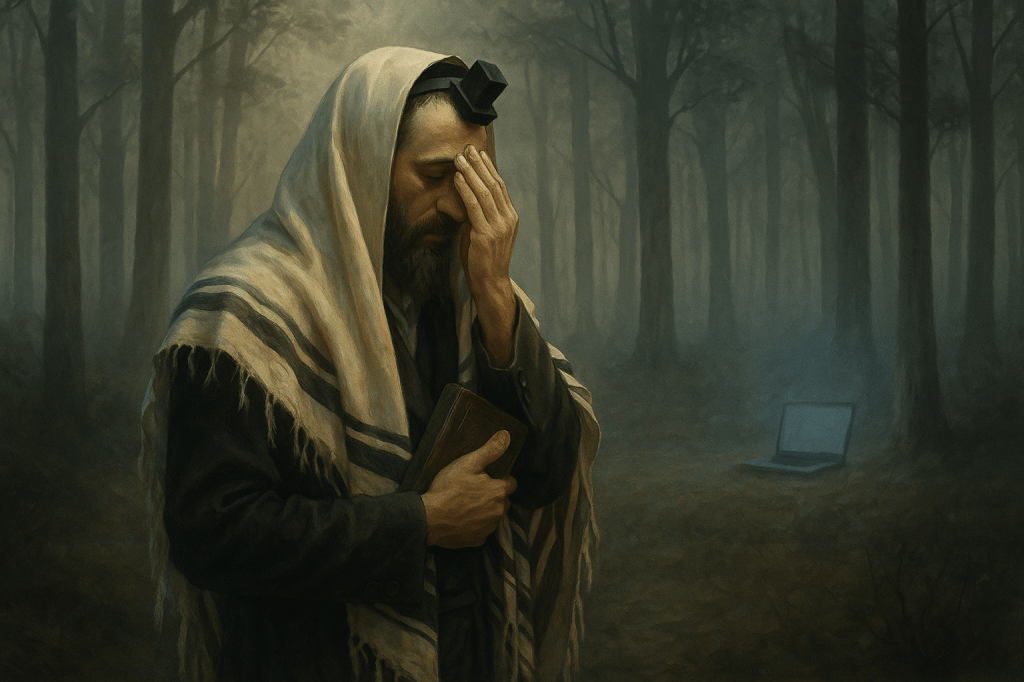
Almost without thinking, I caught myself doing the opposite while I engaged in my weekly study. A question about meaning popped into my head, and before I even considered prayer or reflection, I was already typing it into a search bar. An answer came back in seconds.
The contrast struck me. We live in an age of immediate gratification. A question forms, and within moments a screen gives us a response. But sacred life was never designed for speed. It was designed for struggle.
Wrestling vs. Answering
The very name Israel means “one who wrestles with the Divine.” Jacob’s night-long struggle by the river was not about pinning an opponent but about refusing to let go of the encounter. He walked away limping, but also transformed.
AI, by contrast, specializes in neat solutions. It condenses complexity into clarity. It gives us the appearance of certainty without the bruises, the waiting, or the slow transformation that comes from wrestling.
When answers come too quickly, do we risk losing the encounter altogether?
A Lesson from This Week’s Parsha (Deuteronomy 31)
In this week’s parsha, Moses stands at the edge of his life, preparing Israel for a future without him. He tells the people:
“Chazak v’ematz — Be strong and courageous.”
Not just military advice, but spiritual instruction: cultivate resilience in the slow struggle. Strength is not measured in speed, but in the ability to endure.
And yet, only a few verses later, the Divine warns:
“Haster astir — I will surely hide My face.” (Deut. 31:18)
This is the language of hester panim, the hiddenness of the Divine. Silence, distance, absence. But even this hiddenness is part of the covenant. It teaches us to keep faith when there is no immediate reassurance, to wrestle in the dark, trusting the relationship is still there.
AI, by contrast, never hides its face. It always answers, always responds, always fills the silence. And maybe that’s exactly the danger. If hester panim is part of covenant, then the constant availability of instant answers risks training us away from the very muscles Moses wanted strengthened: courage, patience, resilience.
Rabbi Sacks and the Temptation of Speed
Rabbi Jonathan Sacks once wrote that technology has given us the power to connect instantly, but not the patience to build community. In Morality: Restoring the Common Good in Divided Times, he warned that we risk outsourcing our moral compass to the marketplace of likes and clicks.
Listening again to his BBC series Morality in the 21st Century, I hear the same theme: moral life is slow. It requires listening, compromise, debate, and a willingness to live with uncertainty. That is what covenant demands.
If our public square is already distorted by immediacy, what happens to our spiritual lives? If we get used to fast answers everywhere else, how do we hold onto the patience required for prayer, study, or the mystery of the Divine?
The Golden Calf of Our Age
The Israelites grew restless when Moses lingered on the mountain. They wanted immediacy, visibility, predictability. The Golden Calf was not only an idol; it was a shortcut. Something they could see and control instead of waiting on an unseen, silent Presence.
Our modern calves are not golden, but digital. AI dazzles with responsiveness. It feels near-instant, always available, almost omniscient. But like the Calf, it cannot covenant. It cannot demand patience or change us through silence. It only reflects back what we feed into it.
And perhaps, like the Calf, it tempts us away from sacred struggle by offering immediate gratification.
A Word From the Sages
The sages of the Talmud often celebrated questions more than answers. Rabbi Hanina taught: “I have learned much from my teachers, more from my colleagues, but most from my students.” (Ta’anit 7a)
Elsewhere the Talmud declares: “Turn it, and turn it again, for everything is in it.” (Avot 5:22) Torah is inexhaustible precisely because it resists being closed down into a single neat answer. Its purpose is to draw us deeper, not to satisfy us quickly.
The act of staying in the struggle — of refusing the shortcut — is itself holy.
The Cost of Speed
Sacred practices have always been “slow technologies.” Prayer forces us to pause, to recite words we may not fully understand. Torah study asks us to sit with contradictions, to argue across centuries, to accept that meaning unfolds slowly. Even silence itself — unanswered prayer — is a teacher.
Immediate gratification short-circuits that process. When “Why, Lord?” becomes “Hey AI, why?”, we still ask the question, but the muscles of patience, humility, and endurance go unexercised.
We get the answer. But we lose the wrestling.
Not an Enemy, but a Mirror
AI is not evil. It is a mirror. It reflects our hunger for certainty, our impatience with ambiguity, our discomfort with waiting. It can enrich our study, open new doors of insight, even help us uncover layers of Torah.
But, as my Rabbi reminded, it cannot covenant. It cannot wrestle with us. It cannot demand transformation. Those require something slower, riskier, more sacred.
Reclaiming Sacred Struggle
So perhaps the invitation is not to abandon technology, but to reclaim the spaces it cannot touch. To carve out moments where questions are left unanswered. To let the weight of mystery rest on us a little longer. To resist the temptation to reduce wrestling to Googling.
Maybe the next time a question rises — about meaning, suffering, or purpose — we won’t type it into a box right away. Maybe we’ll write it as a prayer instead. Sit with it. Offer it upward. Wrestle with it.
Because if Jacob became Israel by refusing to let go of the Divine, then maybe our task in an age of instant answers is to refuse to let go of the sacred struggle.
Shalom Aleichem
 On Second Thought
Leave a comment