A short story by Ezra Nadav
When a familiar place feels different, Pip learns that courage can look like staying — gently, together, and with care.
Pip the Squirrel had always believed that the forest spoke in layers.
Some sounds announced themselves — the morning birds calling back and forth, the thud of paws landing on branches, the river laughing over stones.
Other sounds took patience. The settling of leaves after wind. The way moss seemed to breathe if you stayed long enough. The soft rhythm of things growing without being watched.
And then there were the sounds that could only be noticed when you realised they were missing.
Pip noticed them one morning while carrying his journal beneath his arm.
He stopped halfway along the path, listening.
Everything was there — the birds, the breeze, the river — and yet something felt thinner, like a song missing a harmony you couldn’t quite hum but always expected.
Pip frowned, then shook his head. He had slept poorly. That happened sometimes.
He kept walking.
But the feeling returned the next day. And the day after that.
Eventually, Pip stopped arguing with it.
There were two winding paths through the forest. One curved through warm sunlight, where bark felt friendly beneath your paws and berries ripened quickly. The other slipped into shade, where the air cooled and moonflowers liked to bloom.
Once — before Pip could remember clearly — the two paths crossed.
Pip didn’t remember the crossing clearly — not as an event, not as a story — but his paws remembered it. They slowed there without being told. His tail always flicked, just once, as though expecting company.
Lately, he had noticed himself walking past the crossing more quickly.
Not because he meant to.
Just because it felt different now.
One afternoon, Pip stopped anyway.
The place where the paths once met didn’t look broken. Nothing was cracked or fallen. It simply felt… unused. Like a chair no one sat in anymore.
Pip sat down.
He told himself he was only resting. But he stayed longer than he planned.
As the light softened toward evening, a gentle flutter passed overhead. A bat landed nearby, folding his wings with great care.
“Oh,” Pip said. “Hello.”
The bat smiled. “Hello. I’m Tov.”
They sat together for a while without speaking. Pip noticed that Tov didn’t rush the quiet. He seemed to listen to it, the way Pip did.
“I used to stop here,” he said eventually. “It helped the night feel welcoming.”
Pip nodded slowly. “It helped the day feel less alone.”
Tov glanced toward the trees where the sunlight faded. “It feels different now,” he said, not sadly — just truthfully.
“Yes,” Pip replied. “I think it does.”
They didn’t say anything else. They didn’t need to.
The next morning, Pip returned.
Sunlight spilled through the branches, warming the bark beneath his paws. A chipmunk darted along the path, then slowed when he saw Pip sitting there.
“Oh! Hello,” he said. “I’m Ori.”
“I’m Pip.”
Ori looked around the crossing, as though trying to remember something just out of reach. “My grandmother used to stop here,” he said. “She said it was a good place to notice who else belonged to the forest.”
Pip felt the words settle — not as an answer, but as something to hold.
Not in a sudden way. Not like a bright idea snapping into place.
More like the way a stone fits better in your pocket the longer you carry it.
Pip liked that.
He stayed a little longer after Ori left.
That evening, Pip carried all of it back to his oak hallow where he lit a small lantern and opened his leaf journal. He didn’t write straight away. He listened first — to the creak of branches, to the night settling into itself.
When Pip did begin, he wrote slowly, the way he always did when something felt delicate.
He wrote about the crossing — not as it had been, but as it felt now.
He wrote about Tov’s voice, and how the quiet around it seemed to listen back.
He wrote about Ori’s grandmother, and the way memory could travel further than footsteps.
He paused often, resting his paw on the page, letting the words find their own pace.
Over several evenings, the pages filled.
Only then did Pip do something that made his tail twitch with uncertainty.
He chose one leaf from his journal — not the neatest, not the longest — just one that felt ready. He read it again, folded it carefully, and set it beside his lantern while he slept.
The next morning, Pip carried the leaf with him to the place where the paths almost met.
He placed it gently on the ground.
Then he stepped back.
And waited.
The leaf stayed through the morning breeze.
It stayed through the afternoon warmth.
When Pip returned the next day, it was still there — and beside it lay a smooth stone, placed just so, as though someone had worried the leaf might wander away.
Pip didn’t touch either.
A few days passed.
A feather appeared, pale and careful.
Then another leaf — folded differently from Pip’s, but with the same quiet intention.
Later still, a small lantern was left nearby. It wasn’t lit. It didn’t need to be.
Pip noticed that creatures began to pause again.
Not for long.
Not all at once.
They arrived more thoughtfully now. Some came together. Some stayed close to the edges. Some stood in silence before moving on.
But they stayed.
Sometimes Pip saw Tov at dusk, wings tucked in close.
Sometimes Ori came in the early light, pausing longer than before.
Sometimes they missed each other by moments.
Sometimes they exchanged a soft greeting that didn’t need explaining.
No one hurried the crossing.
One afternoon, Pip noticed something new: a thin branch laid carefully across the narrow space between the paths. Not a bridge. Not an invitation.
Just a place to rest.
A paw.
A wing.
Pip sat nearby and let himself feel it — not relief exactly, and not sadness either. Something steadier. Something that said: this matters, even now.
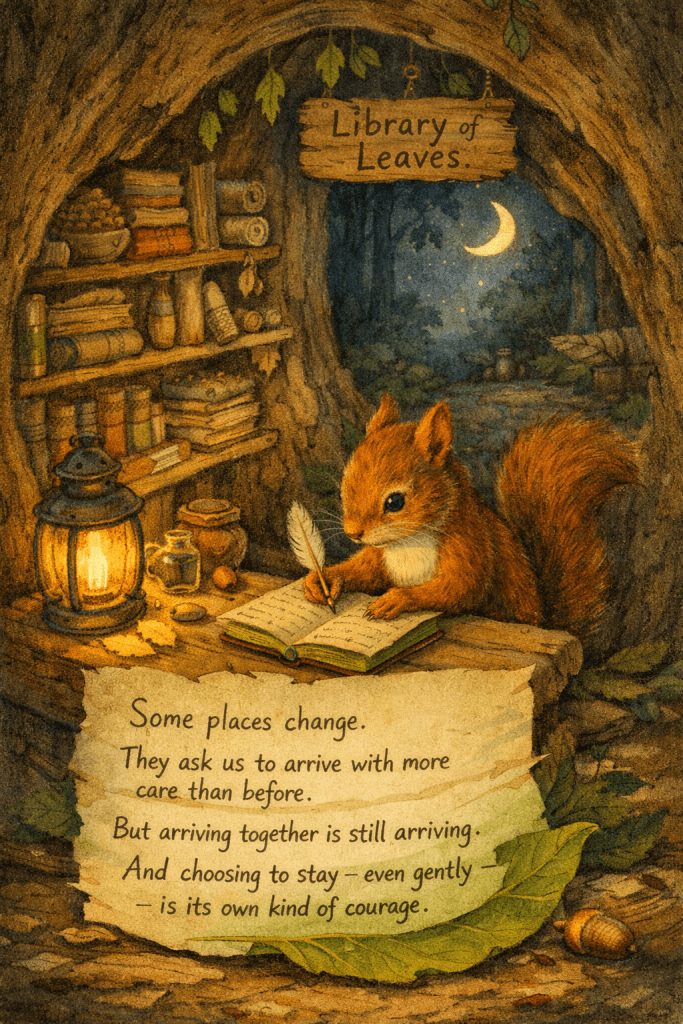
That evening, by lantern light, Pip opened his journal once more. This time, he wrote for the Library of Leaves.
Some places change, he wrote.
They ask us to arrive with more care than before.
Sometimes we don’t notice the distance growing until we miss it.
But arriving together is still arriving.
And choosing to stay — even gently — is its own kind of courage.
When Pip closed the journal, the forest breathed around him.
It wasn’t the same as it had been.
But it was still here.
And so were they.
The End . . . For Now.
Author’s Note — Pip and the Place Where Paths Once Met
This story is not about the world outside the forest.
It is about us.
Tov and Ori are not representatives of different peoples, religions, or cultures. They are both Jewish. They belong to the same forest, the same lineage, the same inherited story — even if they now move through it differently.
The night path and the day path are not opposites. They are expressions.
Ways of living Jewish life that once crossed easily, without comment or self-consciousness, and over time grew quieter, more separate, more cautious — not because of disagreement, but because of drift.
The separation in this story is not caused by harm in the moment. It is generational. It happens softly. Almost politely. So softly that no one notices it fully until something feels thinner — until a harmony is missing.
Bondi is not named in the story, but it is present in its emotional gravity.
After Bondi, the question is no longer whether we prefer to cross.
It is whether we recognise that we must.
Not because it is comfortable.
Not because it returns us to what was.
But because Jewish survival — and Jewish wholeness — has always depended on our ability to arrive together even when it feels different than before.
Pip is not a leader or a reconciler. He does not convince, correct, or persuade. He notices. He stays. He records. He places something gentle in the space and waits.
That is the model this story offers:
that tikkun does not always look like repair with tools, but like attention with patience.
The branch is not a bridge.
The paths do not merge.
The forest does not return to ease.
What changes is the choice.
This story exists because after Bondi, neutrality is not enough — but neither is panic. The imperative is presence. To show up across our internal distances. To sit in the shared places again. To risk the awkwardness of crossing, or resting, or simply being seen together.
If a child reads this as a story about staying gently, it has done its job.
If a Jewish adult recognises themselves in it, that is not an accident.
This story is my way of saying, quietly and without accusation:
We have drifted.
And now, we must choose each other again.
— Ezra Nadav
 On Second Thought
Leave a comment