
by Ezra Nadav
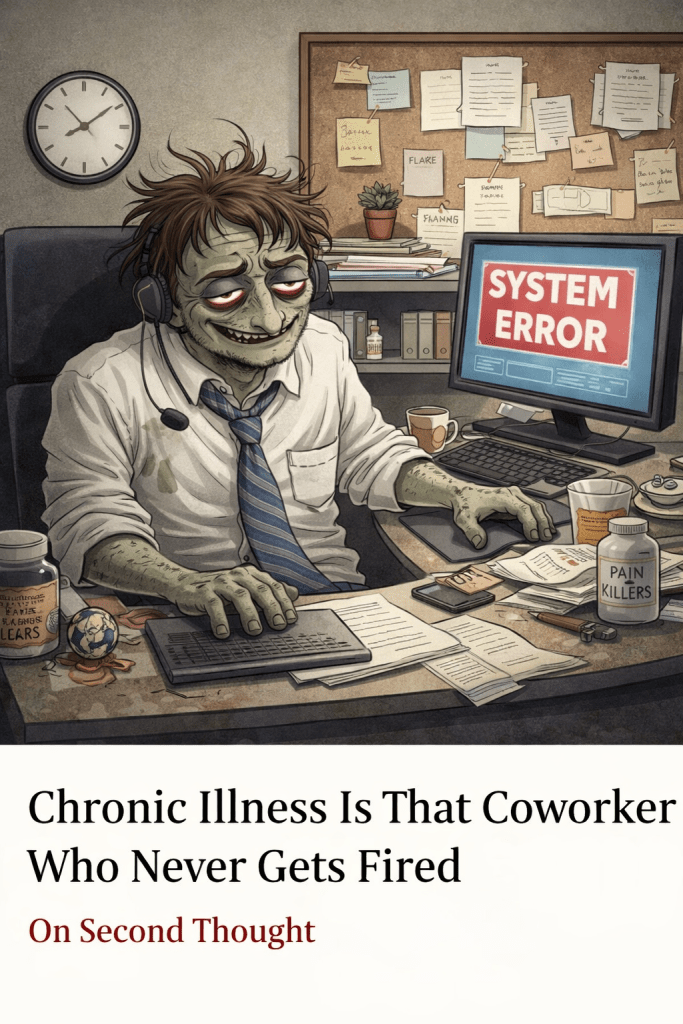
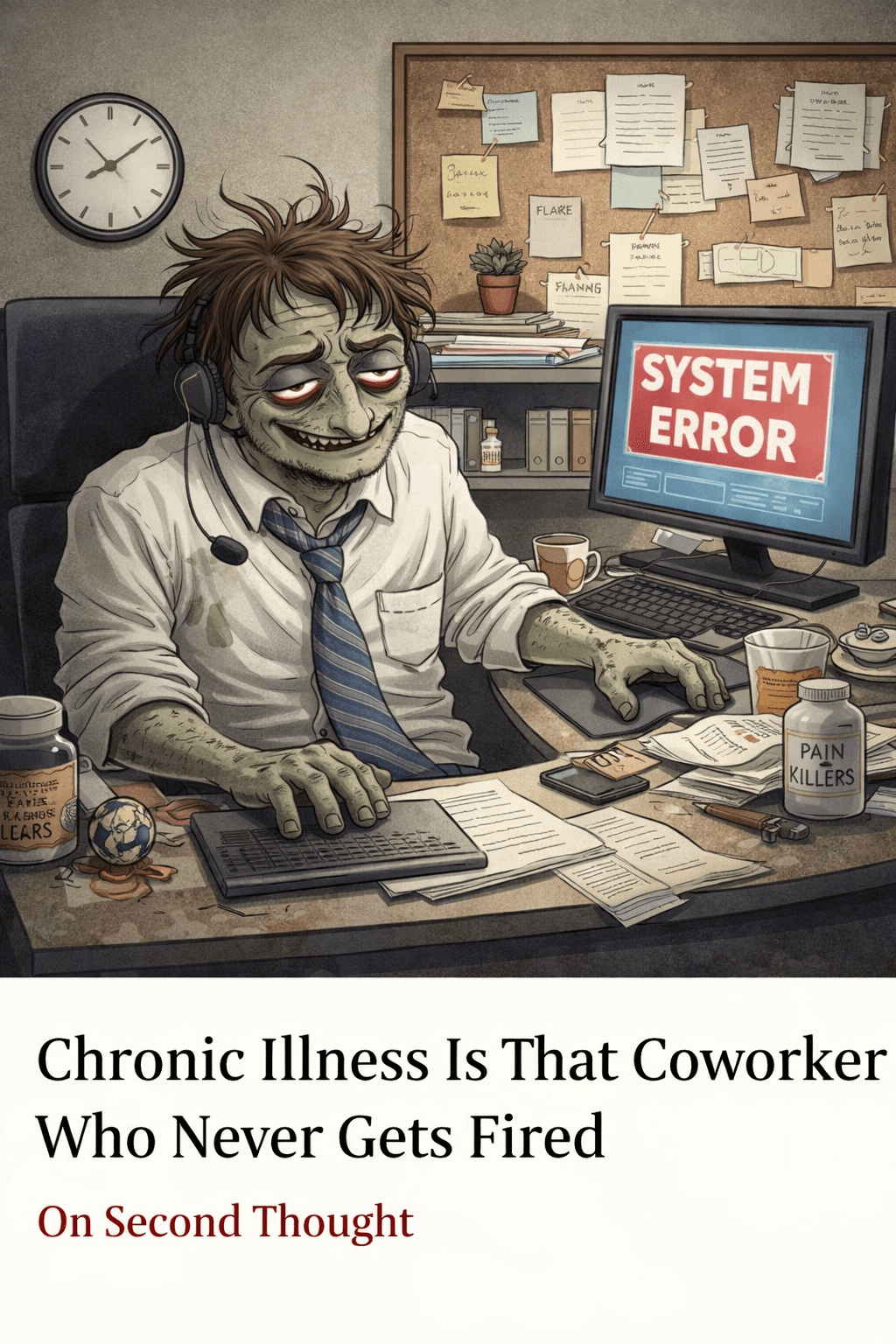
Some days, chronic illness isn’t tragic — it’s just deeply annoying. A dark-humoured look at what it’s like to negotiate daily life with a body that won’t cooperate, won’t explain itself, and somehow never gets performance-managed.
There is a particular kind of rage that comes from realising you have once again been scheduled to work closely with someone who is deeply incompetent, wildly inconsistent, and immune to performance management.
I am talking, of course, about chronic illness.
Chronic illness is not the dramatic villain people imagine. It does not storm in with a cape or monologue. It is far worse than that. Chronic illness is the coworker who has been here forever, knows exactly how to stay just within policy, and somehow survives every restructure.
You don’t remember hiring them. You certainly don’t remember agreeing to a permanent contract. Yet here they are. Every day. Logging in late. Leaving early. Breaking things and blaming “systems issues.”
On paper, they sound manageable. Some good days, some bad days. Flexible work arrangements. Reasonable adjustments. Self-care. In practice, they are chaos wearing a lanyard.
They never do the same job two days in a row. One day they mess with your legs. The next day it’s your skin. Then your nerves. Then your fatigue levels. Sometimes all of the above, just to keep things interesting. They are nothing if not innovative.
You try to document patterns, because that’s what responsible professionals do. You keep notes. You track triggers. You notice correlations. You bring charts to the meeting like a fool who believes evidence will matter.
Chronic illness nods politely, thanks you for your contribution, and then does whatever it was planning to do anyway.
It also has an incredible talent for timing. Important presentation? Big weekend planned? A rare stretch of feeling almost okay? That’s when it strikes. It does not sabotage your life constantly — that would be obvious and unprofessional. It waits until stakes are high. It understands optics.
And somehow, despite all this, you are the one under scrutiny.
You are asked whether you’ve tried managing your workload better. Whether you’re getting enough rest. Whether stress might be a factor. Whether perhaps you are focusing on it too much.
Chronic illness sits silently in the corner of the room, arms folded, while you are gently encouraged to reflect on your resilience.
It never has to justify itself. You do.
One of the most galling things about this coworker is how much unpaid emotional labour it creates. You are constantly doing damage control. Reassuring others. Cancelling plans with grace. Explaining, again, that you are not unreliable — your body is.
You become very good at saying things like “I’m fine, just a flare,” which is the workplace equivalent of “The server is down, we don’t know why, and no, there is no ETA.”
You learn to hedge everything. If I’m well. If my body cooperates. If nothing weird happens. Your calendar fills with asterisks. Your future is pencilled in, never inked.
And yet — and this is the truly dark joke — you are expected to maintain morale.
You are expected to stay positive. To demonstrate adaptability. To show gratitude for the days that are merely difficult instead of catastrophic. You are praised for being “so strong,” which is deeply unhelpful feedback when what you actually want is for this colleague to stop deleting random files from your nervous system.
Chronic illness also has a knack for gaslighting. There are days it behaves impeccably. No symptoms. No interference. It brings you a coffee. You think, Maybe we’ve turned a corner.
You let your guard down. You plan something. You trust the silence.
That is when it sends the email.
Subject line: URGENT: New Symptom Just Dropped
No context. No explanation. Just vibes.
And because you have lived with this coworker long enough, you don’t even get angry anymore. You sigh. You cancel. You adapt. You reschedule your life around someone who contributes nothing and consumes everything.
Here’s the part people don’t like to hear: the exhaustion is not just physical. It is existential. It is the slow erosion of certainty. The never knowing whether today’s version of you is the one who can function or the one who needs to retreat.
It is the constant background calculation: How much energy do I spend now, knowing tomorrow might charge interest?
No annual leave accrual fixes that.
And yet — you keep showing up.
You keep doing the work of living. You keep loving people. You keep finding meaning in the margins. You keep building a life in collaboration with someone who actively resists being managed.
That is not inspirational. It is simply true.
On second thought, maybe the real issue isn’t that chronic illness is an unreliable coworker. It’s that there is no offboarding process. No exit interview. No clean handover. Just a long-term arrangement you did not consent to, learning — slowly, imperfectly — how to coexist without letting it define the entire organisation.
Some days, you win. Some days, you don’t. Most days, you negotiate.
And if today you are sick of being sick — not heroically resilient, not bravely optimistic, just deeply, bone-tired of carrying a body that refuses to stay in line — that doesn’t mean you are failing.
It means you are human, doing your job, while the worst coworker you’ve ever had continues to somehow, inexplicably, keep their desk.
HR still hasn’t returned your emails.
 On Second Thought
Leave a comment