
A brief reflection on invisible labour, quiet endurance, and lives that are never optimised
Part of Embracing the Mundane Series
by Ezra Nadav
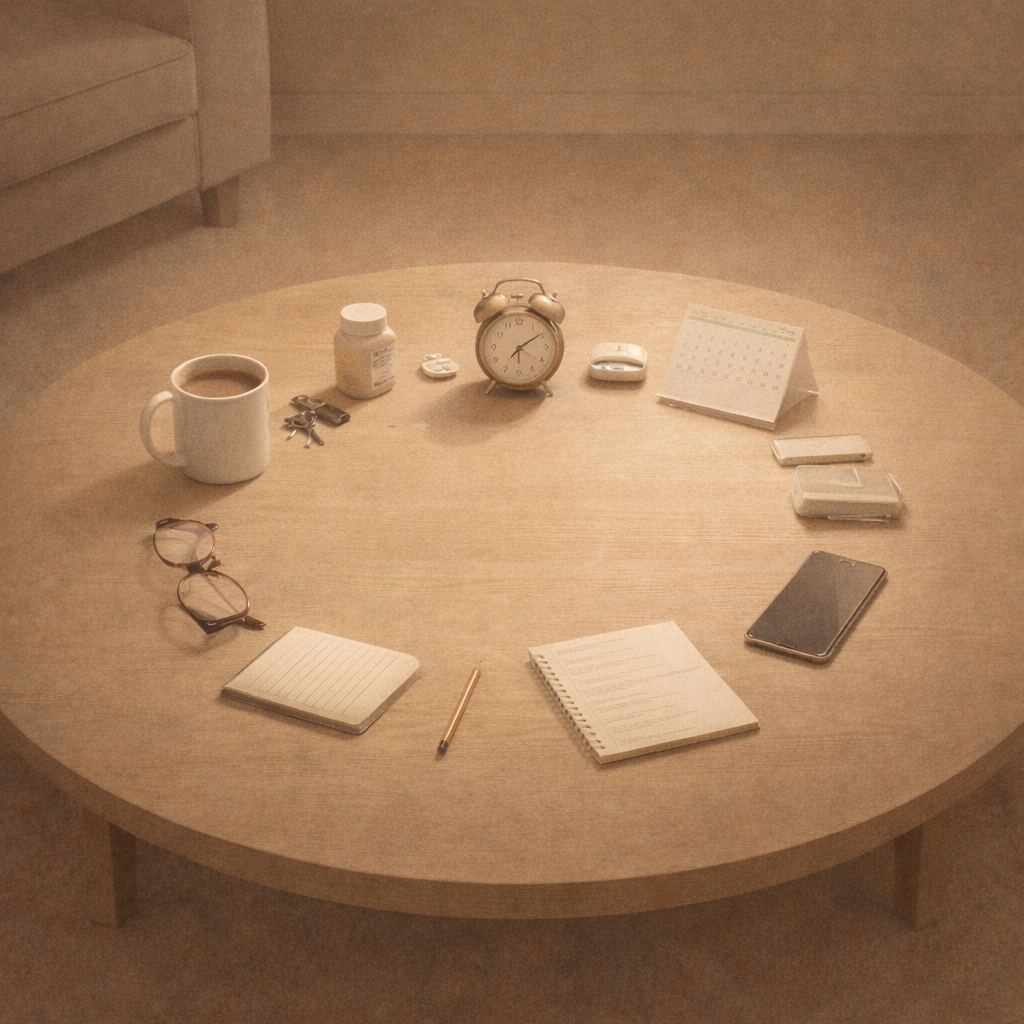
Much of what sustains a life cannot be pointed to.
It does not produce clear outcomes. It does not resolve into achievements that can be named or measured. It leaves no obvious trace beyond the simple fact that things continue to hold.
A meal prepared and eaten without comment.
A conversation that steadies someone without changing anything visibly.
A decision not to say something that might have made things worse.
A body managed quietly through fatigue, pain, or limitation so that the day can proceed.
This is the work that doesn’t show.
It is not exceptional. It is not narratable in ways that travel easily. It does not accumulate into a story of progress or transformation. In many cases, it is not even recognised by the person doing it as work.
And yet, without it, very little would endure.
Across this series, I have tried to name some of the ways ordinary life is misread — how maintenance becomes invisible, how adequacy becomes suspect, how repetition is mistaken for stagnation, and how meaning is sought in moments that stand out rather than in the patterns that sustain.
The work that doesn’t show sits beneath all of this.
It is the quiet effort required to keep going when nothing is resolving. The ongoing adjustments made in response to changing circumstances. The small acts of care that prevent deterioration but do not produce visible improvement.
This kind of labour is difficult to value because it resists comparison.
There is no clear way to measure how much patience was required. How much restraint was exercised. How many small decisions were made to hold something together rather than let it fracture. It does not translate easily into metrics, and so it is often excluded from what counts.
But exclusion does not make it insignificant.
In many lives, this is the majority of the work.
Not the moments of achievement or recognition, but the ongoing effort to remain engaged, to continue showing up, to absorb pressure without transmitting it outward. This is particularly true in contexts of care — for others, for oneself, for systems that require constant attention to remain functional.
It is also true in lives shaped by constraint.
Chronic illness, financial pressure, family responsibility, social marginalisation — these conditions do not always produce visible narratives of overcoming. More often, they require sustained adaptation. The work is not to transcend limitation, but to live within it without collapsing.
This is a form of endurance that rarely attracts attention.
It is not dramatic. It does not resolve cleanly. It does not necessarily lead to improvement in any conventional sense. But it is real, and it is demanding.
To recognise this work is to expand the definition of what it means to live well.
It is to include not only what can be achieved, but what can be maintained. Not only what can be built, but what can be carried. Not only what can be optimised, but what can be endured.
This does not require turning endurance into a virtue to be celebrated.
There is no need to romanticise difficulty or elevate struggle into something inherently meaningful. But it does require acknowledging that many lives are sustained through forms of labour that are not visible enough to be recognised, and not measurable enough to be rewarded.
The absence of recognition does not diminish their value.
If anything, it reveals something important about the limits of the frameworks we use to assess a life. When value is tied primarily to visibility, output, or progression, the work that does not show becomes difficult to see.
And yet it remains.
It is present in the continuity of relationships that have not broken. In the stability of systems that have not collapsed. In the quiet persistence of people who continue to participate in lives that are demanding, constrained, or uncertain.
This is not a conclusion.
It is simply another way of noticing.
That much of what matters most in a life will never be visible enough to count, and that this does not make it any less real.
 On Second Thought
Leave a comment