
By Ezra Nadav
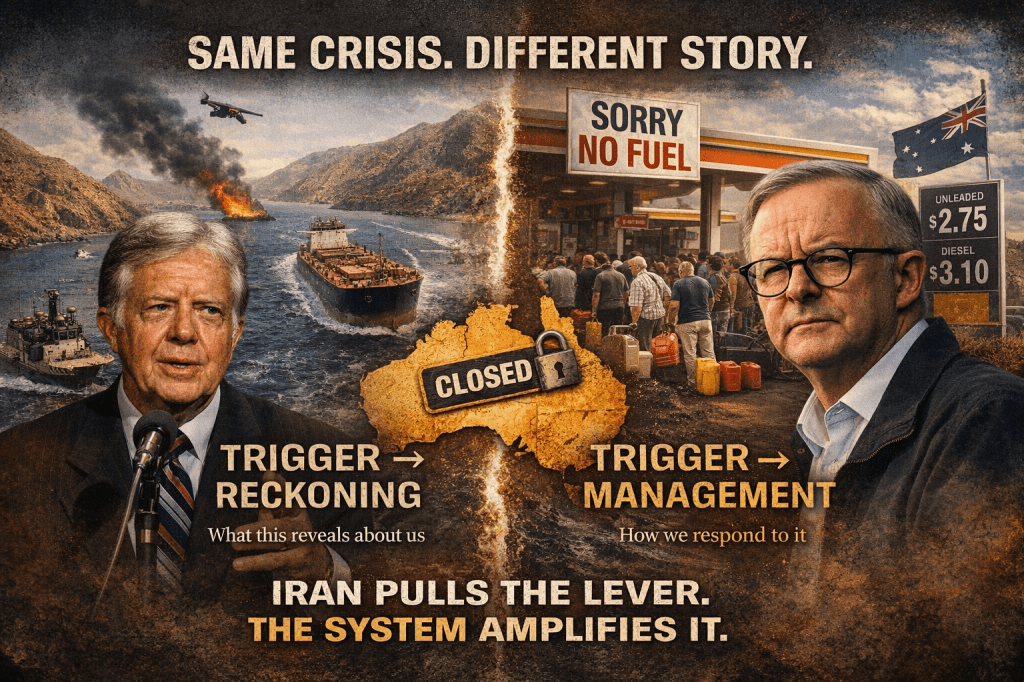
There’s a narrative forming around the current fuel crisis that this is simply something happening to us.
That it’s a distant war.
That it’s market volatility.
That it’s just another global disruption.
That framing is incomplete.
⸻
Let’s be clear about one thing first
Iran is not a passive factor in this crisis.
It is an active one.
• Vessels attempting to transit the Strait of Hormuz have been attacked, blocked, or deterred
• There have been 20+ confirmed attacks on merchant ships since early March
• The IRGC has:
• Used drones, missiles, mines, and fast-attack boats to disrupt shipping
• Imposed selective access—allowing some ships through while excluding others
• Created what analysts are calling a controlled “toll corridor” through the strait
This is not incidental.
It is strategic, deliberate disruption of global energy supply.
And it’s working.
⸻
So yes — Iran (and the IRGC) own a significant part of this
If ships are being attacked, deterred, or forced to reroute:
→ Supply drops
→ Insurance collapses
→ Prices spike
That’s not abstract. That’s operational.
⸻
But here’s the part we can’t ignore
Even with all of that…
If a single chokepoint, controlled by a single actor, can disrupt the global economy this quickly—
Then the problem isn’t just the actor.
It’s the system.
⸻
Because the scale of the impact tells us something
The Strait carries roughly 20% of global oil supply.
So when the IRGC restricts access:
A regional military decision
→ becomes a global economic shock
Not because of scale of force…
But because of scale of dependency.
⸻
This is where most analysis falls short
It picks a side:
• Either “this is Iran’s fault”
• Or “this is a fragile system problem”
The reality is:
Both are true at the same time.
• Iran (via the IRGC) is actively pulling the lever
• The global system determines how much that lever moves the world
⸻
And Australia?
We sit on the receiving end of that equation.
• We import the vast majority of our refined fuel
• We rely on supply chains we don’t control
• We operate with limited buffer
So when disruption happens at the source…
We don’t just feel it.
We amplify it.
⸻
This is the uncomfortable takeaway
Holding Iran accountable matters.
Not naming the IRGC’s role is naïve.
But stopping the analysis there is incomplete.
Because even if the Strait reopened tomorrow:
• The vulnerability remains
• The exposure remains
• The system remains just as sensitive
⸻
Final thought
The IRGC is actively disrupting global supply.
That’s real. That’s deliberate. And it has consequences.
But the fact that this level of disruption is even possible—
That’s on the system we’ve built.
If disruption at the Strait reshapes life in Australia within weeks—
resilience isn’t a future conversation. It’s a current capability gap.
 On Second Thought
Leave a comment