
by Ezra Nadav
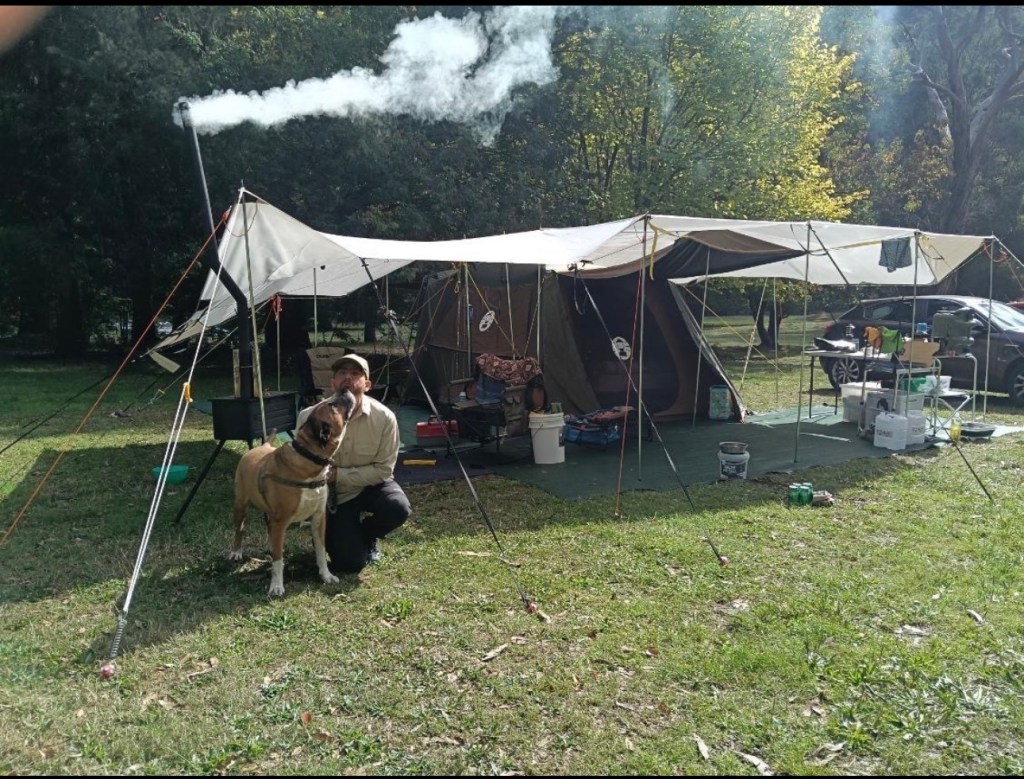
We arrive like everyone else.
A patch of ground.
A car full of gear.
The familiar sequence begins.
Tent out. Poles extended. Stakes in.
It looks, at first, like any other campsite coming together.
But if you watch closely — and some people do — there’s a moment where it stops making sense.
A tarp goes up, but not where you’d expect.
Then another, at a different angle.
The tent isn’t central. The space isn’t symmetrical.
Nothing seems to resolve into a clear picture.
People watch for a while, trying to understand what they’re seeing.
And then, quietly, it clicks.
The tent is not the campsite.
That’s the first shift.
The tent is just where we sleep — a sealed, reliable space that does one job well.
Everything else happens outside of it.
Living, cooking, sitting, moving — all of it is shaped deliberately, but not rigidly.
Tarps are positioned to manage wind before it becomes a problem.
Openings are left where airflow matters, closed where it doesn’t.
The stove sits where heat is useful, not trapped.
It isn’t about creating a perfect structure.
It’s about creating a space that responds.
On one trip, it rained hard for two days.
The kind of rain that usually turns campsites into a series of compromises.
People retreat into tents. Gear gets damp. Movement becomes restricted.
You start managing problems instead of enjoying the place you came to be.
We didn’t have that experience.
The living space stayed dry.
The tent stayed dry.
Nothing needed to be moved or rescued or rethought at 2am.
Not because the gear was exceptional — though it’s good, and that helps.
But because the system had already accounted for what might happen.
Rain wasn’t something to react to.
It was something we had already made space for.
Most people try to solve camping by improving the object.
A better tent.
A bigger tent.
More features. More coverage. More of everything.
But the problem isn’t usually the object.
It’s the assumption that the object should do everything.
Sleep. Shelter. Living. Protection. Storage.
When one thing tries to do everything, it inevitably does some of those things poorly.
So we separate them.
The tent becomes a place to sleep.
The tarps become a way to shape the environment.
The layout becomes a quiet agreement between the two.
What emerges isn’t more complex.
It’s actually simpler — just more intentional.
There’s a moment, usually on the first evening, when someone nearby will wander over.
They’ll say something like:
“I was watching you set up. I couldn’t figure out what you were doing at first.”
And then, after a pause:
“But it makes sense now.”
What they’re noticing isn’t the gear.
It’s the absence of friction.
No scrambling when the wind shifts.
No urgent adjustments when the rain starts.
No sense that something is about to fail.
Just a space that holds.
There’s something in that, beyond camping.
We often try to solve complex situations by reinforcing a single structure.
Make it stronger. Bigger. More capable.
But sometimes the better move is to stop asking one thing to carry everything.
To separate functions.
To allow space for adaptation.
To design with the environment, not in opposition to it.
Not rigid. Not reactive.
Just quietly prepared.
It was never about the tent.
It was about how the pieces work together.
And how, when they do, everything else gets easier.
 On Second Thought
Leave a comment