
Part 1: In the Beginning: Conception and Innocence
A part of the ‘On Second Thought‘ series
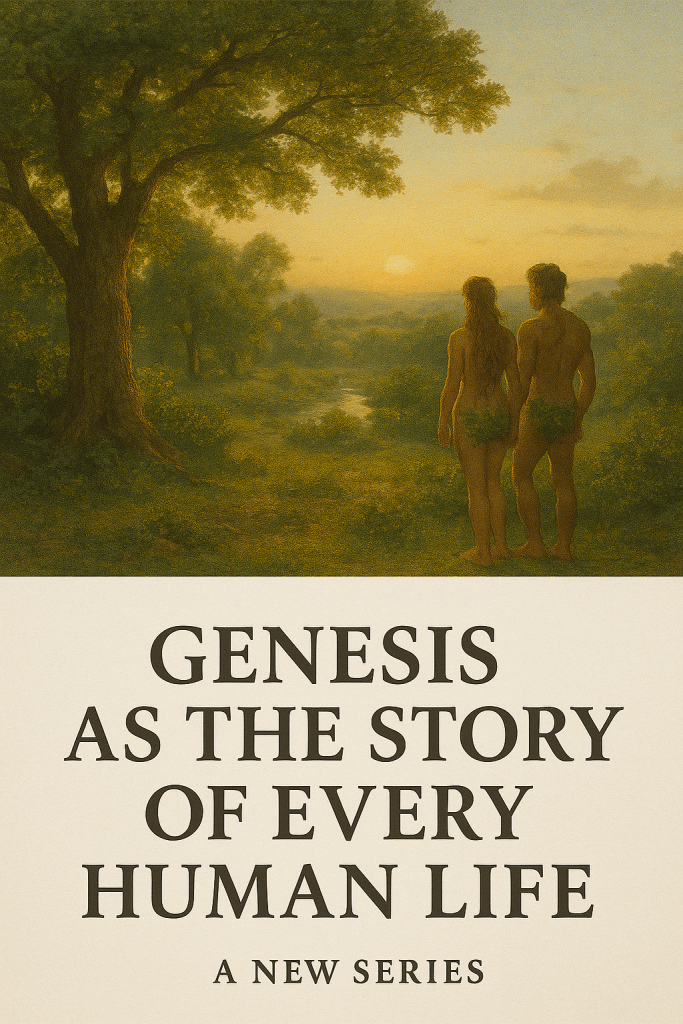
By: Ezra Nadav
Genesis Is Our Story Too: A New Series on Growth, Loss, and Becoming.
What if Genesis wasn’t just a story about the world’s beginning, but about your beginning too?What if its pages didn’t just tell us what happened “then,” but mapped the very journey of human life: from innocence to experience, from rivalry to reconciliation, from dreaming to blessing
Over the coming weeks, the On Second Thought Series will explore Genesis not only as sacred history, but as a profound metaphor for the life of every human soul.
Part 1: In the Beginning: Conception and Innocence
In the Beginning:
In the beginning, there was no striving.
No fear.
No separation.
Just being, and being called good.
The opening lines of Genesis are often read as cosmic history, a grand account of how the universe unfolded from formless void into flourishing life.
But what if they are also something more intimate? What if they tell us not only about the beginning of the world, but about the beginning of every human soul?
Each of our lives begins, like the world itself, in darkness and hiddenness, in the mystery of formation. We are knit together, unseen, until the moment when breath fills our lungs and we emerge into the light.
The Abundance of The Garden:
In those earliest stages of life, we are much like Adam and Eve in the Garden:
Cared for without knowing who cares for us.
Surrounded by abundance without yet needing to earn it.
Vulnerable yet safe.
It is a time before striving, before shame, before the anxious question of “Am I enough?”
It is a time of given goodness, a gift, not an achievement.
Nothing is asked of us yet, except to receive life itself.
But innocence is not a permanent state.
It was never meant to be.
Even in Genesis, the seeds of change are sown early:
- The presence of choice.
- The setting of boundaries (“You shall not eat…”).
- The knowledge that love without freedom is not truly love at all.
The Garden is a beautiful beginning, but it is not a final destination.
It is a starting place, sacred, yes, but one we are destined to leave.
A Necessary Price:
Our first chapters are the same. We are not meant to remain forever in the simplicity of childhood. Life calls us out of the garden, sometimes gently, sometimes by force, into a world where we must grapple with knowledge, risk, suffering, and agency.
We will taste fear.
We will feel jealousy.
We will hunger for more.
We will make choices that cannot be undone.
And in doing so, we will lose something essential, and yet, paradoxically, we must lose it in order to become who we are meant to be.
This loss is not a punishment.
It is the necessary price of growth.
Without it, we would remain untested, unrealised, unfinished.
Still, beginnings matter. Even as we move beyond them, they are not erased.
They remain, hidden but indelible, woven into the marrow of our being.
They remind us that before we could perform or fail, before we could impress or disappoint, we were simply… good.
Given.
Loved into existence.
A Yearning to Return:
There is, perhaps, a longing in every human heart for the lost garden: a yearning to return to a place where we are accepted without condition, where being is enough. We seek it in our relationships, in our ambitions, even in our spiritual lives.
But Genesis does not offer a return to Eden. It offers something harder, and more beautiful: the path of becoming.
To honour our beginning is not to try to recreate it. It is to carry its truth with us, to let it anchor us when the world demands our worth be proven, to let it remind us that before any achievement or failure, there is a goodness in us that precedes all striving.
We were, from the very first breath, called good.
And even as we journey forward, through loss, struggle, reconciliation, and blessing, that goodness remains the first word spoken over us, and the last.
“And God saw everything that He had made, and behold, it was very good.”
וירא אלהים את כל אשר עשה והנה טוב מאד
(Genesis 1:31)
Coming Next:
In Part 2, Knowledge and Estrangement, we leave the garden and enter the world of moral awakening, where innocence gives way to self-awareness, freedom introduces consequence, and the first relationships fracture.
As the story of Genesis unfolds, so too does our own: we begin to grapple with shame, envy, and the complexity of being truly seen. But even here, in the ache of separation, something essential is taking root, the beginning of conscious life.
Shalom Aleichem

 On Second Thought
Leave a reply to Covenant and Identity – Becoming a Self: Part 3 – On Second Thought Cancel reply