
Genesis as the Story of Every Human Life: Part 2
A part of the ‘On Second Thought‘ series
By: Ezra Nadav
Previously in the Series:
In Part 1, Conception and Innocence, we explored the Edenic beginnings of human life — a time of unearned goodness, unconscious trust, and belonging without condition.But innocence, however beautiful, is not permanent. As Genesis teaches us, we are not meant to stay in the garden. The next stage of the journey begins when our eyes open — and we discover what it means to know, to choose, and to be changed by that knowing.
Part 2: Knowledge and Estrangement – The Loss of Innocence
We do not remain in the garden. We never could.
The second movement of Genesis, and of life, begins not with rebellion, but with awakening. An awakening to choice. To consequence. To the aching complexity of the world.
Adam and Eve eat from the tree, and their eyes are opened. It is not their death that arrives immediately, but their self-consciousness. They see themselves differently. They see each other differently. They hide.
This is not just a story of disobedience, it is the story of the first time a human being knew that they were vulnerable. The first time someone feared being seen. The first moment shame cast its long shadow over a soul that once knew only belonging.
Estrangement:
And so begins the age of estrangement.
From God.
From one another.
Even from ourselves.
Like the transition from infancy to childhood, this moment marks the end of total innocence and the beginning of moral agency. We learn, as children do, that not every desire can be fulfilled. That actions have consequences. That trust can be broken. That we are capable of hurting, and of being hurt. We learn to lie, and we learn to hide.
We discover that to be known fully can feel dangerous.
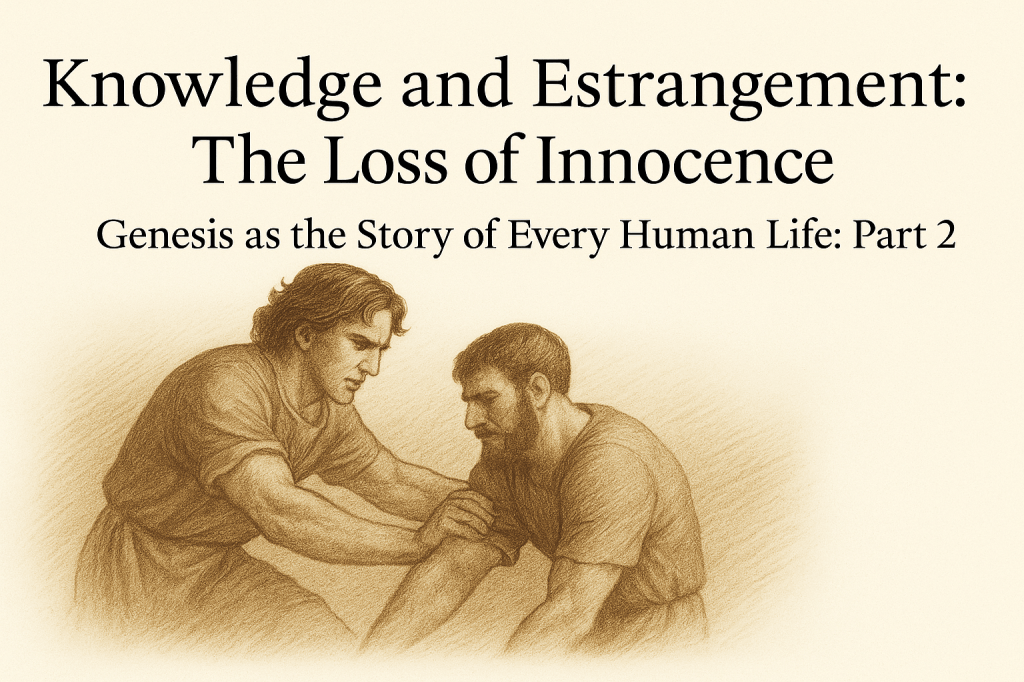
With Cain and Abel, that estrangement deepens. The first sibling relationship becomes the first rivalry. Comparison turns to envy. Envy turns to violence. It is not God who destroys paradise, it is humanity turning against itself.
The story escalates quickly, but not unnecessarily. Genesis does not flinch from the truth, that what begins with shame can evolve into rage, and that unresolved pain often becomes punishment directed outward. We lash out because we do not know how to name our ache.
Innocence Lost:
We isolate because we fear we are already beyond repair.
And yet, this too is part of becoming human.
Part of growing up.
Not a detour, but a stage.
Not a failure, but a threshold.
The loss of innocence is not just an individual event, it is a universal passage. We all encounter moments when the world no longer feels safe. Moments when the people we trust fail us, or we fail them. Moments when we realise that knowing right from wrong does not guarantee we will always choose rightly. Sometimes, the knowledge of what is good arrives long before the strength to act on it.
In this stage of life, we discover the burden of freedom. And with it, the ache of alienation. The burden is not simply to choose, but to carry the outcomes of those choices. The ache is not just in being alone, but in knowing we once were not.
Estrangement takes many forms:
From the parent who once seemed all-knowing, but now feels distant or fallible. From the community that once nurtured us, but now feels conditional, measured, perhaps even demanding. From the inner sense of wholeness we did not realise we had, until it slipped away. We look back, confused, asking when exactly the garden disappeared behind us.
Some try to avoid this passage, clinging to childlike simplicity, denying the complexity of moral life. Others rush through it, hardening into cynicism, deciding that goodness is naïve and trust is weakness. But both are strategies of avoidance. Both miss the path that Genesis subtly offers.
Because even here, even in the story’s descent, something remarkable happens. Even Cain, the murderer, is not discarded. He is marked, not as condemned, but as protected. The story is severe, but it is not hopeless.
As we grow, we must learn to live without the garden, but not without goodness.
We are called to choose our lives, even when it would be easier to blame others. We are called to reckon with the shadow side of freedom, and to keep walking anyway. The pain of knowing is real, but it is also the beginning of deeper knowing.
The loss of innocence is not the end of the story. It is the beginning of conscious relationship: with ourselves, with others, with the sacred. It is only after exile that covenant becomes possible. Only after rupture that real intimacy can be chosen rather than assumed.
Only once we know we are naked can we begin the long work of becoming clothed in truth.
Closing Quote:
“Then the eyes of both of them were opened, and they knew that they were naked, and they sewed fig leaves together…”
(Genesis 3:7)
Coming Next:
In Part 3, Covenant and Identity, the Genesis story shifts from exile to encounter, from estrangement to the slow work of becoming someone.
Through the lives of Abraham, Isaac, and Jacob, we explore what it means to be called, to wrestle, to carry a name that doesn’t yet fit.
This is the season of formation, where identity is not inherited but forged, not claimed in certainty but discovered in tension. It is here that we begin to walk with purpose, and to wonder who we are becoming in the process.
Shalom Aleichem
 On Second Thought
Leave a reply to Genesis as the Story of Every Human Life: Part 1 – On Second Thought Cancel reply