This story sits alongside the one I’ve just shared about Murray Cohen.
It doesn’t retell his experience—it holds a piece of what he carried, in a different language.
To read more about Murray, you can find his story here:
The Music He Carried
By Ezra Nadav
In Oak Hallow, where Pip the squirrel lived, there were many kinds of songs.
There were the bright songs—the ones that skipped between branches in the morning.
There were the soft songs—the ones that curled into nests at dusk.
And there were the quiet songs.
The quiet songs were different.
They didn’t ask to be heard.
They simply stayed.
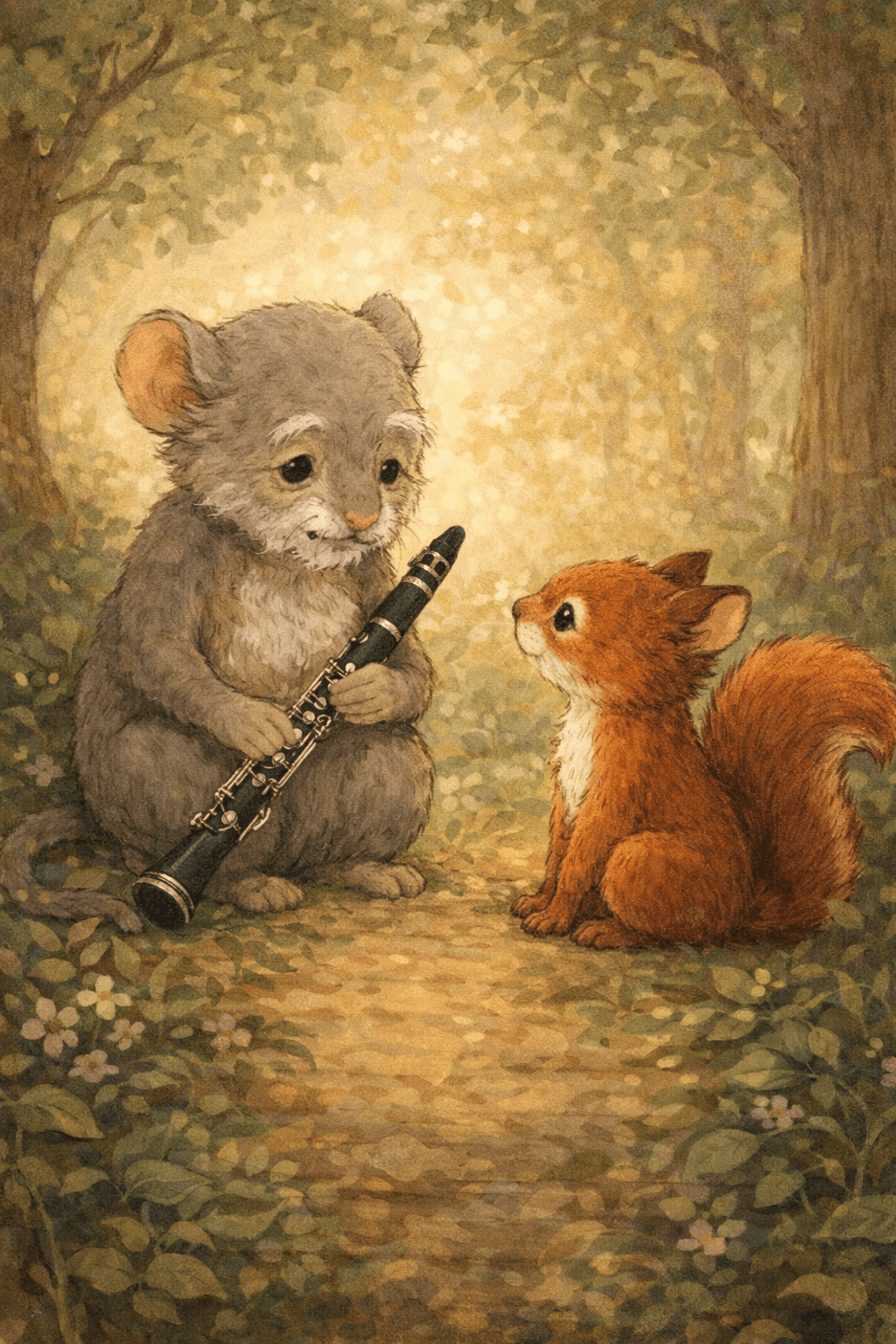
One evening, as the light slipped gently through the leaves, Pip noticed someone new at the edge of the clearing.
He was an older animal—small, with fur that had long since turned silver.
He sat very still, holding something slender and worn between his paws.
Pip tilted his head.
It wasn’t quite a flute. Not quite a reed.
But when the old one lifted it to his mouth, the air changed.
The sound that came out wasn’t loud.
It didn’t travel far.
But it held.
Pip crept a little closer.
“Hello,” he said softly.
The old one lowered the instrument and looked at him—not startled, not surprised. Just… present.
“Hello, Pip.”
Pip blinked. “You know my name?”
The old one gave the smallest smile. “Oak Hallow carries its stories well.”
They sat together for a while, not speaking.
Eventually, Pip asked, “What kind of song is that?”
The old one looked down at the instrument in his paws.
“It’s a song that was carried.”
Pip frowned a little. “Carried from where?”
The old one didn’t answer straight away.
Instead, he lifted the instrument again and played.
This time, Pip listened differently.
The song didn’t feel like the others.
It wasn’t trying to be beautiful.
It wasn’t trying to be anything at all.
It just… was.
When the sound settled back into the trees, Pip spoke again—more carefully now.
“Was it always your song?”
The old one shook his head.
“No,” he said. “It became mine because I held onto it.”
Pip shifted closer.
“Through what?”
The old one’s gaze moved past the trees, somewhere far beyond Oak Hallow.
“Through a place where many things were taken,” he said quietly.
“And a few things were not.”
Pip didn’t ask what kind of place that was.
Some questions, he was learning, didn’t need to be opened all the way.
Instead, he asked, “Did the song help?”
The old one paused.
Then, with gentle clarity, he said:
“It didn’t make anything better.”
Pip’s ears lowered slightly.
“But,” the old one continued, “it was something I could still carry when everything else was being decided for me.”
They sat with that.
The wind moved softly through the leaves.
After a while, Pip said, “Do you still need to carry it?”
The old one looked at him again—this time with something warmer in his eyes.
“Yes,” he said. “But now I get to play it.”
And he did.
The song was still quiet.
Still steady.
But there was something else in it now—not brightness, not quite joy—but a kind of space.
As if the song no longer had to hold everything on its own.
Pip listened until the last note disappeared.
Then he said, very softly, “I think I’ll remember that one.”
The old one nodded.
“That’s how songs are carried now.”
That night, as Pip curled into his nest in Oak Hallow, he noticed something.
The clearing was as it had always been.
The trees hadn’t changed.
The wind hadn’t changed.
But there was a new kind of quiet resting there.
Not empty.
Not heavy.
Just… held.
And somewhere in that quiet, the song remained.

