
By Alex Sturman, PCC
Authors note: This reflection explores the intersection of Jewish ethical teaching, leadership development, coaching, and organisational learning. While written from a contemporary leadership perspective, the teachings are drawn from Pirkei Avot (Ethics of the Fathers), a tractate of the Mishnah devoted to ethical conduct and character development.
Among the many texts that shape Jewish ethical thinking, few are as practical as Pirkei Avot.
Unlike much of the Mishnah, Pirkei Avot is not primarily concerned with ritual law. Instead, it asks a more enduring question:
What kind of person should we become?
As someone who spends much of my professional life working in leadership development, organisational learning, and coaching, I am continually struck by how often modern leadership challenges have already been considered by our sages.
The language may differ. The context may differ. Human nature has not changed nearly as much as we imagine.
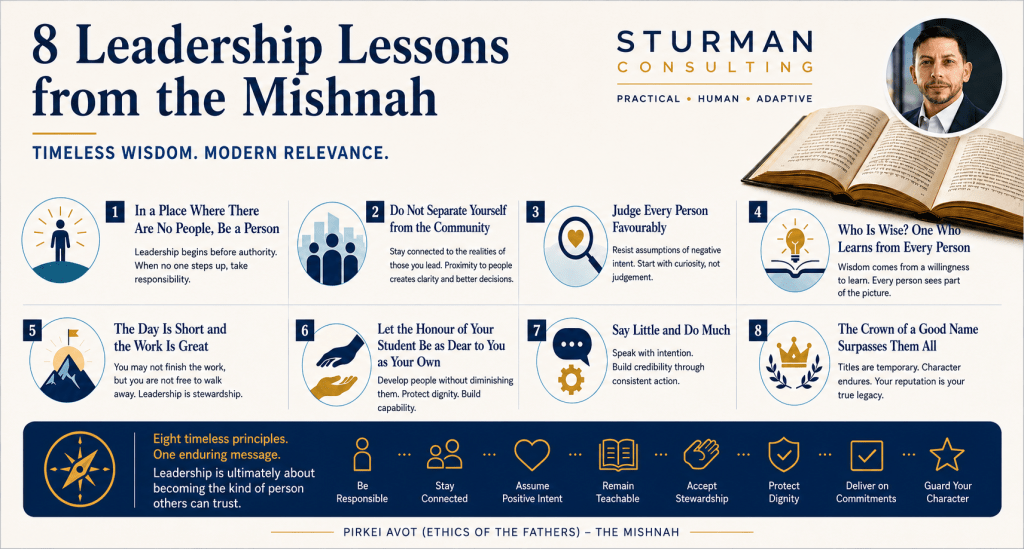
Leadership Begins with Responsibility
Hillel teaches:
“In a place where there are no people, strive to be a person.”
Leadership begins when we stop asking, “Whose job is this?” and begin asking, “What is my responsibility here?”
The Mishnah does not call us to heroism. It calls us to accountability.
Leadership Requires Connection
The Mishnah cautions:
“Do not separate yourself from the community.”
Leaders who lose connection with the people they serve eventually lose touch with reality itself.
Jewish leadership has never been envisioned as leadership from above. It is leadership from among.
The shepherd walks with the flock.
Leadership Begins with Curiosity
Joshua ben Perachiah instructs us:
“Judge every person favourably.”
In organisational life we often rush to conclusions.
The Mishnah encourages restraint. Before assuming poor intent, ask what else might be true.
This is not merely ethical wisdom. It is operational wisdom.
Leadership Requires Humility
Ben Zoma asks:
“Who is wise?”
His answer remains one of my favourite teachings:
“One who learns from every person.”
Wisdom is not accumulation. Wisdom is openness.
The most effective leaders I have encountered are rarely the loudest people in the room. They are often the most curious.
Leadership Is Stewardship
Rabbi Tarfon reminds us:
“The day is short and the work is great.”
Few leaders will ever finish the work before them. The task is not completion. The task is faithful contribution.
We inherit unfinished work from those who came before us and pass unfinished work to those who follow.
Leadership Protects Human Dignity
The Mishnah teaches that the honour of our students should be as dear to us as our own.
In contemporary language, this is a reminder that capability development and human dignity are inseparable.
People learn best when they feel respected. People flourish when they feel safe to grow.
Leadership Is Demonstrated Through Action
Shammai teaches:
“Say little and do much.”
Judaism consistently places action above intention.
Leadership is no different. The question is never what we intended to do. The question is what we actually did.
Leadership Is Ultimately About Character
The Mishnah concludes that the crown of a good name surpasses every other crown.
This may be the most important leadership lesson of all.
Titles disappear. Positions change. Organisations evolve.
Character remains.
A person’s good name is built one interaction, one decision, and one act of integrity at a time.
A Final Thought
Modern leadership literature often focuses on influence, performance, and strategy.
Pirkei Avot begins elsewhere. It begins with the human being. Before asking whether we are effective leaders, the Mishnah asks whether we are becoming worthy people.
Perhaps that is why these teachings continue to endure. Leadership, in the Jewish tradition, is not primarily about directing others.
It is about refining ourselves so that others may safely follow.

