
by Ezra Nadav
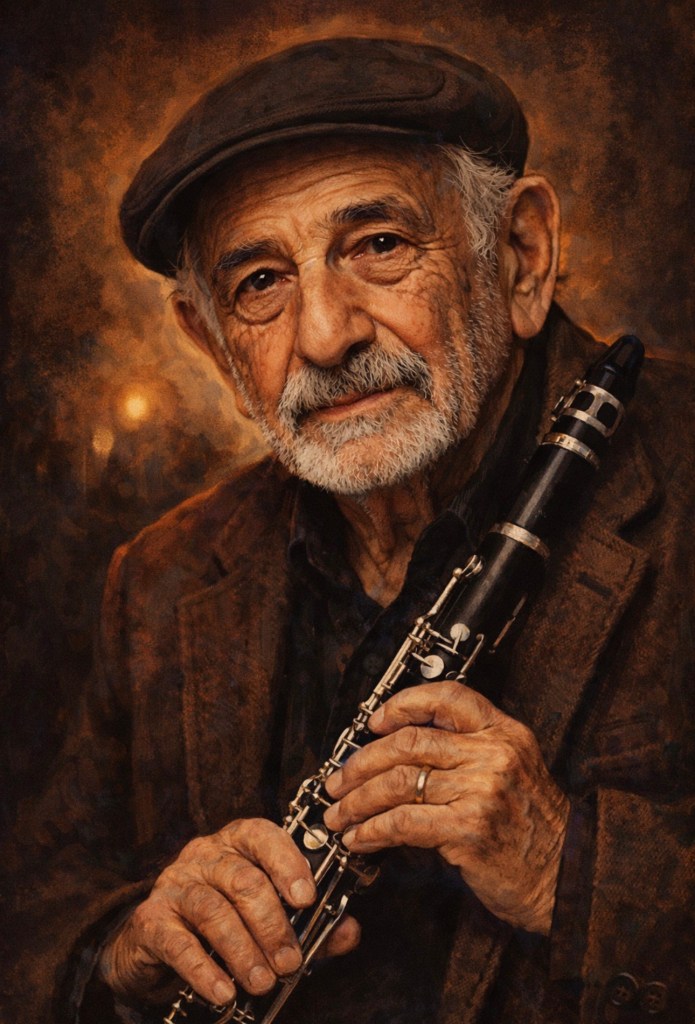
Murray Cohen never told his story all at once.
It came in fragments—over coffee, in passing comments, in the space between one story and another. You had to sit with him long enough to understand that what sounded like a memory was often a doorway. And if you stayed, really stayed, he would sometimes let you walk a little further through it.
He was a boy when the world ended, when the Shoah began in earnest.
Barely a teenager when he was taken—moved through camps whose names he would sometimes say and sometimes not. It wasn’t forgetfulness. It was choice. There are things that survive by being spoken, and things that survive by being held.
What he did speak about, with a kind of quiet clarity, was music.
Music was not a comfort in the way people like to imagine. It didn’t soften anything. It didn’t make the camps less brutal, less final. But it was something that could not be fully taken from him—and in that, it became dangerous.
The commandant noticed.
Murray never described the man in moral terms. Not kind. Not cruel. Just… precise. A man who understood power the way others understand language.
He liked Murray’s music.
That was enough.
The boy was pulled, at times, from where he would have otherwise been. Taken along as the commandant moved between postings. Not rescued—never that. Relocated. Preserved, but only in the way an object is preserved. Something of use. Something of interest.
Murray understood that.
He survived not because someone saw his humanity—but because someone claimed ownership over it.
There was a story he told me once that has never left me.
The commandant had been away. SS business, he said, with a shrug that carried decades in it. In his absence, the order around Murray loosened. Or perhaps it tightened in a different direction.
A lower-ranking officer took a dislike to him.
Murray didn’t dramatise what followed. He didn’t need to. The way he paused, the way his hand hovered unconsciously near his ribs as he spoke—it was enough.
He was beaten. Not once. Not briefly. Beaten with the kind of sustained intent that ends lives.
He should have died.
When the commandant returned and saw what had been done, he assembled the camp.
Murray told this part without embellishment. Just the sequence.
The officer was brought forward. There was no trial. No questioning. The commandant didn’t raise his voice.
He shot him.
In front of everyone.
For a moment—just a moment—when you hear a story like that, there’s a temptation to reach for meaning that makes it easier to hold. Protection. Retribution. A line drawn in defence of a child.
Murray never allowed that.
“It wasn’t for me,” he said.
It was a demonstration.
A message to the other men: this one is mine.
Not a life spared. A possession defended.
That distinction mattered to him. Even decades later, even after everything that came after.
Because Murray survived. But he never confused the conditions of that survival with anything resembling care.
After liberation, there was no immediate return to life as it should have been. There were years in displaced persons camps—time that doesn’t get spoken about as often, but lingers in its own way. The long in-between. The waiting. The slow reconstruction of something like a future.
Eventually, he made his way to New York.
And there, something shifted.
Music was no longer something that kept him alive in the narrowest sense. It became something he could live through.
He found his way into jazz.
Played in rooms where people gathered not out of fear, but out of hunger for sound, for connection, for something unscripted and alive. He played with extraordinary musicians—including Nina Simone—though he spoke of that with the same understated tone he used for everything else. No performance in the telling. Just fact.
But if you listened closely, you could hear it: the same thread.
Music had carried him. Not cleanly. Not heroically. But continuously.
From camp to camp.
From survival to something resembling a life.
Murray Cohen was one of the most remarkable people I’ve ever known.
Not because he survived—though that alone is something most of us cannot begin to comprehend.
But because he understood, with absolute clarity, what his survival did and did not mean.
He never dressed it up.
Never allowed it to become a story that made other people more comfortable.
He carried it as it was.
And somehow, in the middle of all of that, he still made music.
 On Second Thought
Leave a reply to Pip and the Song That Was Carried – On Second Thought Cancel reply