by Alex Sturman, PCC
Looking for work has always carried a certain emotional weight.
Even under the best circumstances, there is something exposing about it. You take years of experience, mistakes, growth, leadership, conflict, resilience, skill — all the complicated parts of being an actual human being — and compress them into a few pages that somebody may scan for twelve seconds before deciding whether you continue in the process.
That has never been easy.
But I don’t think we fully acknowledge how much harder the process has become.
Not simply because the market is difficult. Markets fluctuate. Industries change. Organisations restructure. That part isn’t new.
What feels different now is the sheer amount of emotional and cognitive labour required just to participate in the process at all.
You are no longer simply applying for a role.
You are optimising for Applicant Tracking Systems. Tailoring language to algorithms you cannot see. Maintaining an active professional brand. Demonstrating “culture fit.” Signalling adaptability. Networking continuously. Producing evidence of strategic capability. Remaining professionally visible online.
And somehow still expected to project confidence, enthusiasm, and psychological resilience while privately trying to work out what happens if none of this pays off.
For many experienced professionals, the process can feel quietly disorienting.
Particularly for people who built careers during a time where competence, reliability, and reputation carried more weight than personal marketing.
There is a strange grief in realising that decades of experience do not automatically translate into visibility anymore.
You can have led teams, managed crises, designed systems, rebuilt broken programs, carried operational responsibility, supported organisations through instability — and still find yourself receiving a rejection email three minutes after submitting an application.
Sometimes without a human ever reading your name.
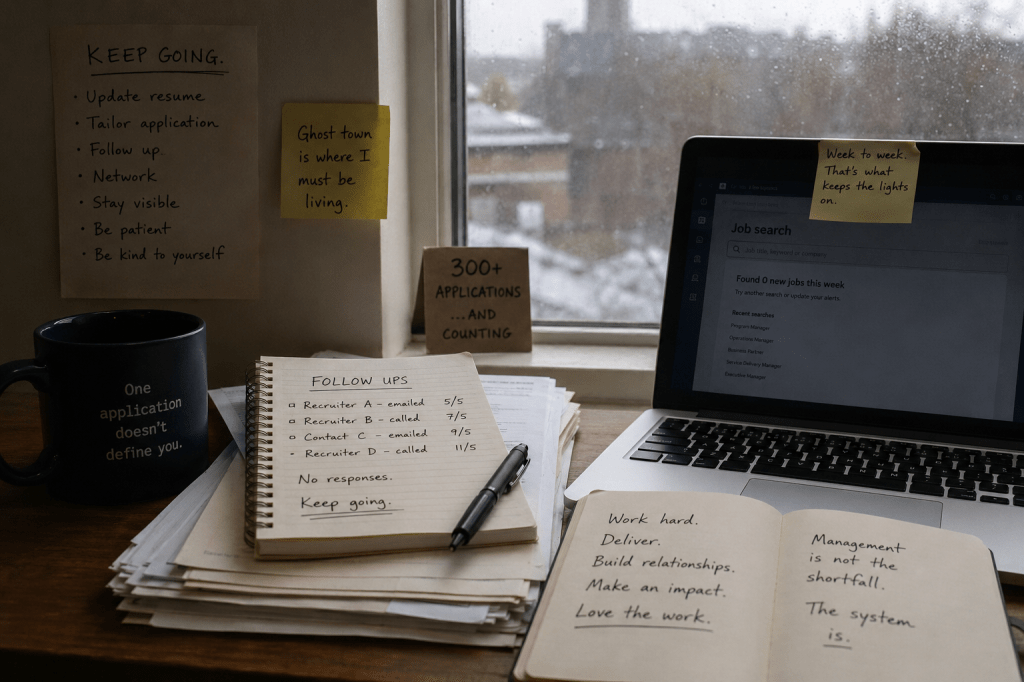
Over the past eight months, I’ve submitted more than 300 applications.
I’m not saying I should have automatically gotten those jobs. But five or ten years ago, I probably would’ve at least had a conversation.
Instead, the process increasingly feels like shouting into administrative weather.
I call the contact person listed on the advertisement to discuss the opportunity. To put a voice to a name and a name to a voice. To understand the organisation beyond the position description.
No callback.
I send follow-up emails to recruiters letting them know I’ve applied. A few days later I follow up again by phone.
Nothing.
Ghost town is apparently where I live now.
At times it feels less like professional recruitment and more like broadcasting signals into empty space hoping somebody, somewhere, is still listening.
And all of this often unfolds while living week to week on rolling contract extensions.
Because contracts are what keep the lights on. Food in the fridge. A roof overhead.
There is a particular exhaustion that comes from simultaneously searching for stability while having to perform it.
Working at breakneck pace to demonstrate not only that you are the person who gets things done, maintains relationships, delivers outcomes, and carries operational responsibility — but also that you genuinely care about the work you are privileged to have, however temporary it may be.
And the truth is, most of the managers I’ve worked with lately are not the problem.
Most are trying to hold impossible workloads together inside systems that are slowing under their own weight. Endless process layers. Shrinking resources. Constant restructuring. Workforce fatigue sitting underneath all of it.
Everybody is tired.
And somewhere inside that machinery are real people trying very hard to remain employable while remaining human.
I think that’s part of what makes modern job searching uniquely exhausting.
A lot of the process now feels like being asked to project confidence while quietly having no idea what your life is going to look like in six months.
You continue tailoring applications after multiple rejections. You remain optimistic while navigating silence. You present strategic confidence while privately calculating rent, medication costs, mortgage repayments, groceries, or whether you can emotionally tolerate another interview panel reducing decades of professional experience into rehearsed behavioural examples.
There is also something psychologically strange about having to repeatedly narrate yourself as a product.
Especially for people whose careers were built around service, care, operational responsibility, or leadership under pressure.
Many highly capable professionals are not naturally inclined toward self-promotion. Some actively distrust it.
And yet the employment landscape increasingly rewards visibility over depth, performance over substance, and confidence over reflection.
Not always.
But often enough that people feel it.
The result is that job searching becomes more than a practical process.
It starts affecting identity.
Because for most people, work is not just income.
It’s routine. Structure. Knowing what day it is. Having somewhere to be on Monday morning. Feeling useful. Feeling competent. Feeling connected to something outside yourself.
It’s the conversations you don’t realise mattered until they disappear.
When employment becomes unstable, people are not simply losing a payslip.
They are often losing the framework that helped organise their lives.
And still, despite all of this, people continue.
They update resumes at midnight. Rewrite cover letters. Attend interviews while carrying private grief. Apply for roles after redundancy. Start again after illness. Pivot industries at 45 or 50. Return to work after burnout.
Keep going after rejection number twenty-seven.
There is a kind of quiet courage in that which rarely gets acknowledged.
Particularly now.
Because modern job searching increasingly requires people to absorb rejection impersonally while experiencing it very personally.
And that is not a small thing.
I don’t think the answer is false positivity or recycled slogans about “staying motivated.”
Most people already know how to work hard.
What many people need is the reminder that struggling within this environment does not automatically mean they are failing within it.
The process itself has become harder.
More competitive. More performative. More technologically filtered. More emotionally demanding.
Recognising that reality is not pessimism.
It is honesty.
And honestly, for many people trying to navigate this right now, honesty probably feels more useful than inspiration.

