
By Ezra Nadav
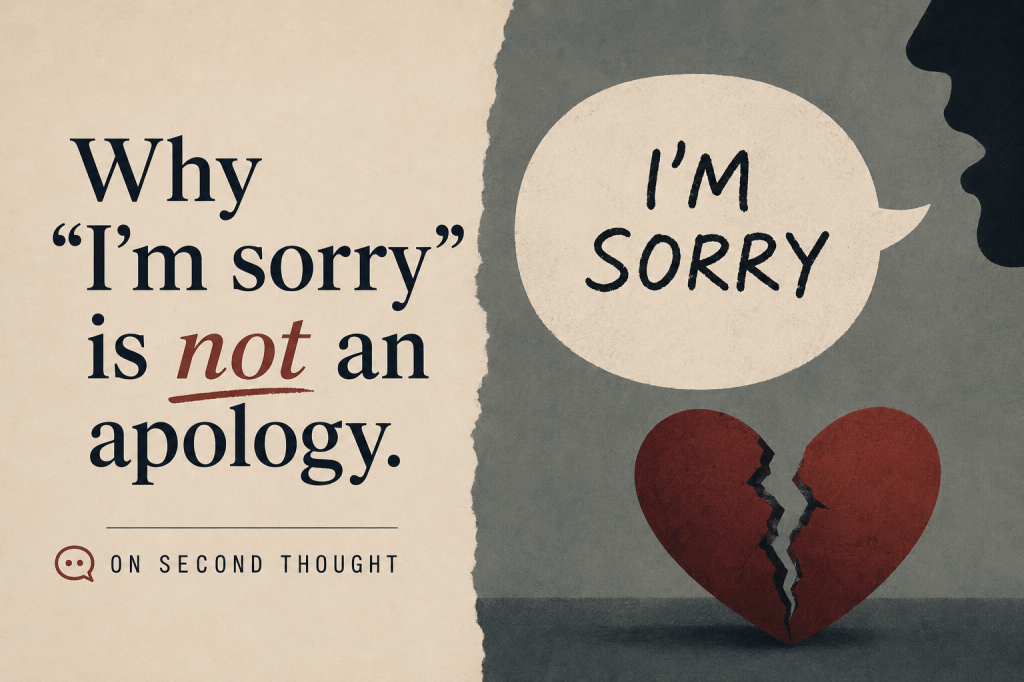
Somewhere along the way, “I’m sorry” became confused with accountability.
It isn’t.
“I’m sorry” can mean many things:
- I’m uncomfortable.
- I want this conversation to end.
- I regret consequences.
- I feel embarrassed.
- I don’t like your reaction.
- I want things to go back to normal.
But none of those things are necessarily an apology.
A real apology contains something far more difficult than discomfort: responsibility.
An apology requires a person to clearly acknowledge:
- what they did,
- the impact it had,
- and their role in causing harm,
without immediately shifting blame, defending themselves, minimising the behaviour, or demanding emotional absolution.
That’s why:
- “I’m sorry you felt that way”
- “I’m sorry but…”
- “I’m sorry you misunderstood”
- “I’m sorry, however…”
rarely feel like apologies at all.
Because they aren’t attempts to repair harm. They are attempts to manage discomfort.
And people can feel the difference.
A genuine apology does not rush toward self-protection.
It stays present with the reality that trust was damaged.
It sounds more like:
- “I spoke to you disrespectfully.”
- “I broke trust.”
- “I handled that poorly.”
- “I can see the impact this had on you.”
- “You did not deserve that.”
- “I need to do better moving forward.”
Notice what is missing: excuses.
Real accountability is emotionally expensive.
That is why so many people avoid it.
Because true apologies require a temporary surrender of ego.
They require a person to tolerate being wrong without immediately trying to become innocent again.
And perhaps this is the part we do not talk about enough; for many people, “I’m sorry” is used not to repair the relationship, but to escape consequences.
The apology becomes transactional:
I said sorry, so now you have to move on.
But forgiveness is not owed simply because someone uttered the words.
Trust is rebuilt through changed behaviour, not emotional phrasing.
A meaningful apology is therefore not measured by tears, intensity, or repetition.
It is measured by:
- ownership,
- behavioural change,
- consistency,
- and whether the harmed person feels safer afterward.
Because in the end, the purpose of an apology is not to help the speaker feel better.
It is to help repair what they damaged.

